
Stories
How vanilla is grown, and why it takes three years
By the LiaKea Beauty Tribe editorial team4 min read
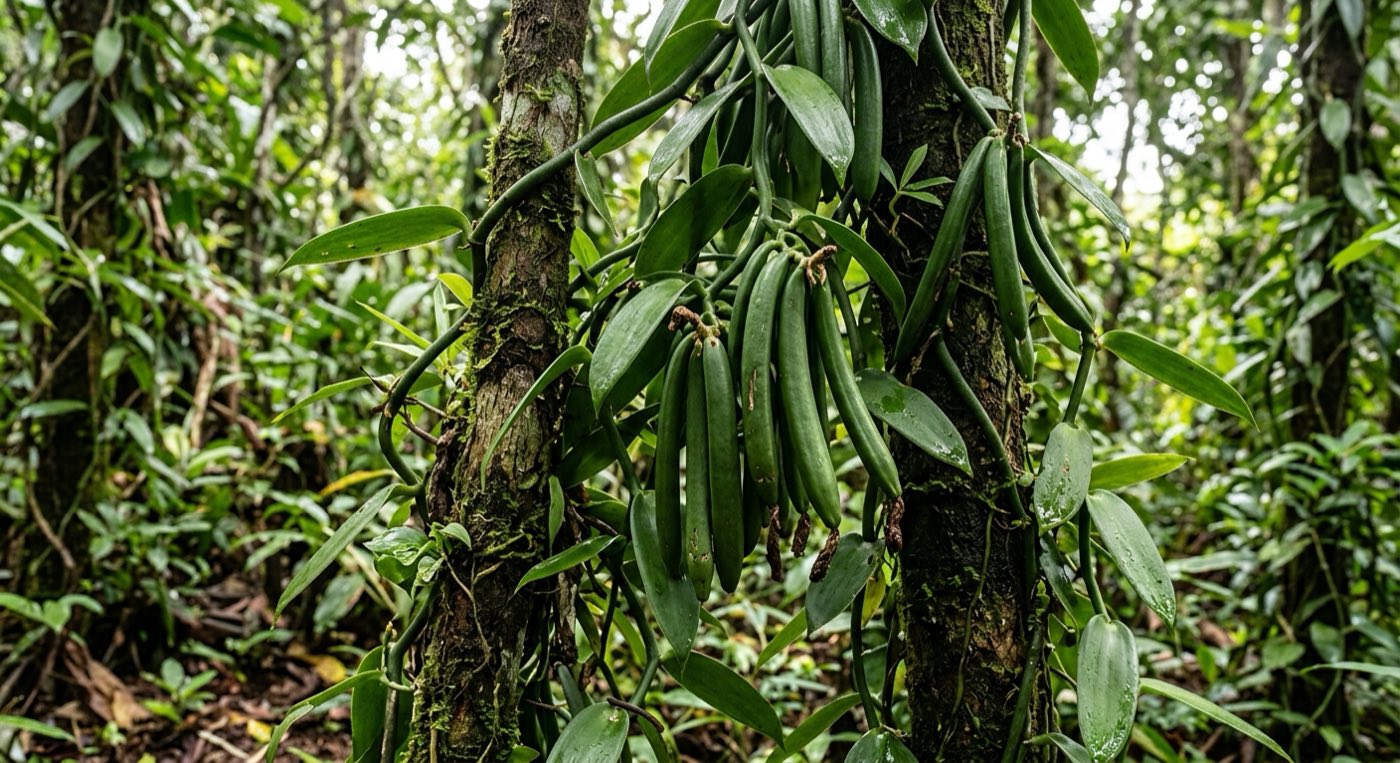
Almost everything about vanilla is counter-intuitive, starting with the fact that it is an orchid. Not a bean, not a spice in the peppercorn sense, but the seed pod of a climbing orchid, Vanilla planifolia, native to the forests of eastern Mexico, where it stayed for centuries before Madagascar took the market.
Why every vanilla flower is pollinated by hand
In Mexico the plant has a partner. Local bees, and to some extent hummingbirds, evolved alongside it and reach the pollen where the flower hides it, behind a small flap of tissue that separates the male and female parts. Take the plant out of Mexico and that partner does not come with it. This is the whole reason vanilla costs what it costs.
The workaround was found in 1841 on Réunion by Edmond Albius, then a twelve-year-old enslaved boy, who worked out that lifting the flap with a sliver of bamboo and pressing the two parts together does what the bee does. That gesture, unchanged in a hundred and eighty years, is still how every commercial vanilla pod in the world begins.
It has to be done by hand, flower by flower, in the few hours the flower is open. A vanilla flower opens once, in the morning, and closes for good by afternoon. Miss it and there is no second chance until the following year.
Three years before a vanilla vine gives its first pod
A vanilla cutting is planted against a support tree and left to climb. It does not flower in its first year, or its second. Around the third it produces its first flowers, and only a fraction of those are pollinated and kept: overload a young vine and it exhausts itself.
The pollinated pods then hang and grow for eight to nine months before they are cut. At that point they are green, they are firm, and they smell of nothing at all. Vanillin, the molecule the whole crop exists for, is not yet free in the pod.
Why green vanilla pods smell of nothing at all
What follows is the part almost nobody pictures. The green pods are killed, usually by a brief immersion in hot water, which stops them growing and starts the enzymatic reactions that will release the aroma. Then they are sweated in boxes, laid in the sun by day and wrapped by night for weeks, then dried slowly, then conditioned in closed boxes for months.
The pods lose around four fifths of their weight. They turn from green to the near black of the vanilla you know. And they gradually become fragrant, which they were not at any earlier point.
Put end to end, from the cutting going into the ground to a pod ready to sell, it is three to four years, one hand-pollinated flower at a time, followed by the better part of a year of daily handling.
What hand-pollination puts under the Madagascar price
When vanilla prices move, and they move violently, the reflex is to look at speculation, at exporters, at the weather. All of that is real. But the floor under the price is this: a crop that cannot be mechanised at its two decisive moments, pollination and curing, both of which are done by hand by people paid at the beginning of a very long chain.
Why we buy vanillin and not pods
Here is the part that does not fit the story, and we would rather say it than leave it out.
After all of that, we buy very little natural vanilla. Our sourcing in Madagascar runs through one colleague on the ground, and what we actually work with is almost exclusively fractions, vanillin made from eugenol rather than anything that came out of a pod.
Two reasons, and they pull in the same direction. Transformed material, extract and absolute, is often adulterated. Untransformed material is honest and its quality swings too widely from lot to lot to build a formula on.
The second explains part of the first. If a buyer needs the same profile in March and in October and the crop will not give it, something has to absorb the difference. Adulteration is usually described as fraud for margin, and some of it is. A good deal of it is a response to a variability the market refuses to pay for.
That is the uncomfortable end of a story about a flower that opens for one morning. The labour is real, the pod is extraordinary, and the industry’s answer to its inconsistency is a molecule.