Mexican vs Madagascar vanilla, and why Mexico lost it
By the LiaKea Beauty Tribe editorial team3 min read
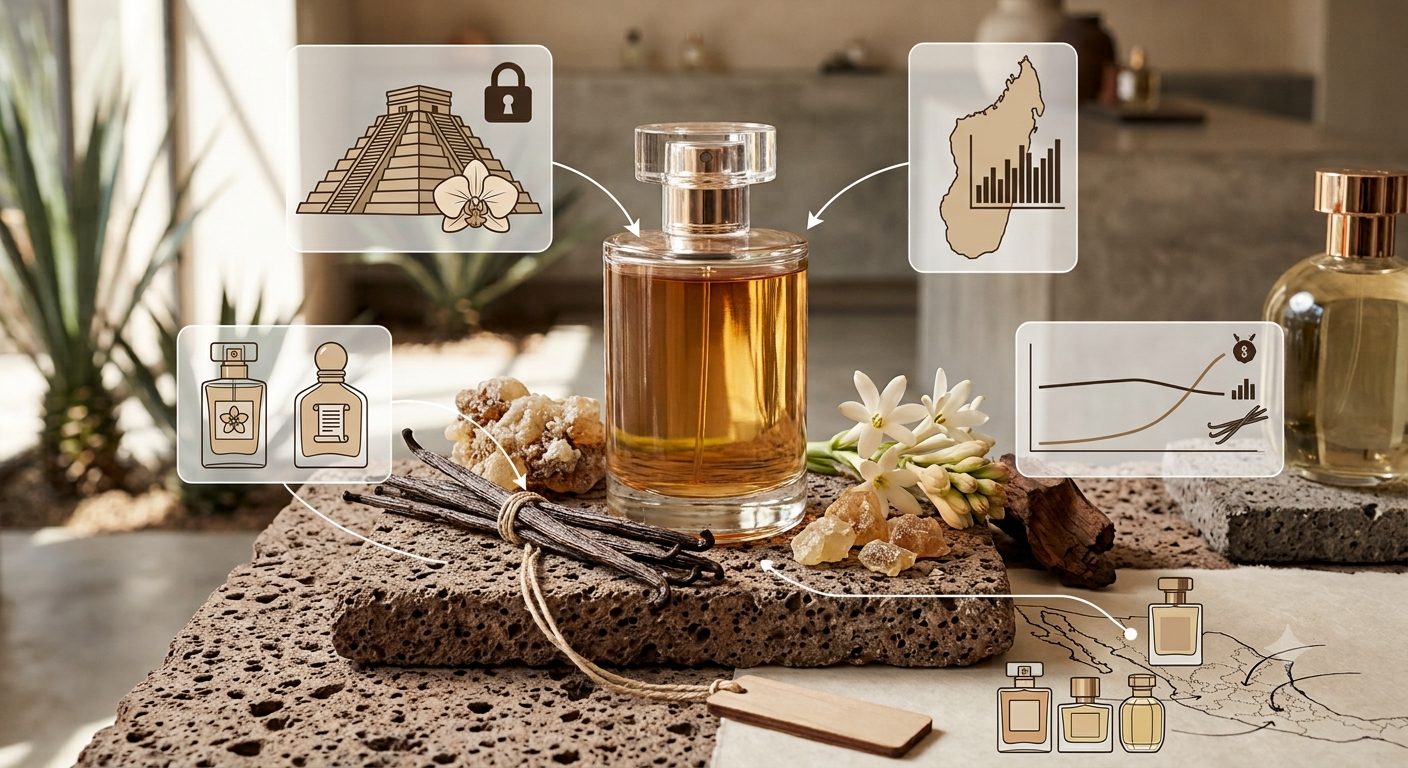
Key figures
- Mexican vanilla production today
~360 metric tons a year, against Madagascar's ~80% share of global supply
As of
- Origin
Vanilla planifolia is native to Mexico; the Totonac cultivated it in the Papantla region (Veracruz) more than 1,000 years before Madagascar grew any
As of
The site’s recurring thread is that a raw material’s origin and its market authority rarely sit in the same place, the exact split behind how the Gulf, not Asia, sets the terms on oud. Vanilla is the oldest, cleanest case of that split there is: the plant is Mexican, the market is Malagasy, and the gap between the two is a story worth reading before assuming “origin” and “supply” mean the same thing.
Mexico invented vanilla, in Papantla
Vanilla planifolia is native to Mexico. The Totonac people of the Papantla region, in the state of Veracruz, cultivated the orchid and its cured pods more than a thousand years before the crop reached the Indian Ocean, and for centuries Mexico was the only place on earth that produced it, partly because vanilla’s natural pollinator, a specific bee, existed nowhere else. That monopoly held until hand-pollination was worked out in the 19th century and the plant could be grown anywhere warm and wet enough.
How Madagascar took over vanilla production
Once the plant could travel, it did. Mexican production declined through the late 19th and early 20th centuries under political instability, land reform, and the arrival of cheap synthetic vanillin (derived from wood pulp and petrochemicals from the 1870s on), just as Madagascar’s plantations were scaling up. By the 1920s Madagascar was the world’s dominant supplier, and it never gave the position back. Today it holds roughly 80% of global vanilla supply, with all the price volatility that concentration brings, the same boom-and-bust swings and state intervention this outlet tracks on the Malagasy side. Mexico, the birthplace, is now down to around 360 metric tons a year, a rounding error against Madagascar’s volume.
What Mexican vanilla is being sold on now
The interesting part isn’t the decline, it’s the repositioning. Rather than compete on volume it lost a century ago, Mexican vanilla is being sold on exactly the thing volume can’t buy: origin. Papantla vanilla carries a distinct sensory profile, more floral and sweet, with a tobacco facet Madagascar’s Bourbon beans don’t have, and thicker, darker pods. Small producers lean on that difference and on the “birthplace of vanilla” narrative to command premium prices in a low-volume, high-story niche, the opposite of Madagascar’s commodity-scale model.
Single origin or main supplier: the vanilla buyer’s fork
For a buyer, the practical lesson is that “single origin” and “main supplier” are two different purchasing decisions, and vanilla makes the fork explicit. If you need volume and predictable (if volatile) availability, that conversation runs through Madagascar, full stop. If you’re building a product where the origin story itself is part of the value, Mexico offers a genuine, defensible provenance that no other country can claim, at a price and a scale that only work for a premium, narrative-led position. It’s the same calculation that decides whether a house sources a material as a commodity or builds a whole identity around where it came from, the logic playing out right now inside Mexico’s own niche perfume houses, several of which build fragrances on that same Mexican vanilla.
Source: Madagascar vs Mexican Planifolia Vanilla Beans: Complete Comparison - VanillaPura
Was this useful?
What was missing?
Noted, thank you. It goes straight to the editorial side.