Why IFRA standards hit jasmine absolute hardest
By the LiaKea Beauty Tribe editorial team5 min read
Key figures
- Jasmine, fourteen years after the alarm
Not banned. Jasminum grandiflorum absolute is capped at 0.7% of the finished product in IFRA category 4 (fine fragrance), Jasminum sambac absolute at 4%
As of
- Who writes the standards
IFRA is funded directly by its Regular Members, the handful of multinational flavour and fragrance producers. Head office Geneva, operations centre Brussels
As of
- Declared EU lobbying, for scale
IFRA has declared between roughly €100,000 and €700,000 a year in EU lobbying costs depending on the year (EU Transparency Register)
As of
In April 2012 The Ecologist ran a piece headlined “Death by jasmine: why organic perfumery is under threat”, arguing that IFRA restrictions falling almost entirely on naturals would regulate independent natural perfumers out of existence.
Fourteen years on, jasmine is not banned. Jasminum grandiflorum absolute is capped at 0.7% of the finished product in IFRA category 4, fine fragrance, and Jasminum sambac at 4% (The Artisan Insider). Natural perfumery did not die either. The headline named the wrong casualty, but the direction of travel it described was right.
Where IFRA restrictions actually land, at the bench
In our own formulation work the constraint almost never arrives as a ban. It arrives as a moment where the natural route stops being viable and the synthetic one is simply there.
Three families do it repeatedly. Powerful hesperidic openings: citrus oils carry furocoumarins, and once you are working to a phototoxicity ceiling you cannot get the brightness from the natural alone. Musks: the natural ones are either prohibited outright or hemmed in tightly enough that the palette is effectively synthetic. Spices: cinnamon bark, clove and nutmeg oils are all restricted, and they are exactly the materials that carry a spicy accord.
None of that is an accident of one amendment. It is three whole olfactory families where the compliant answer is a molecule sold by a large house.
Why jasmine absolute costs more to prove than a molecule
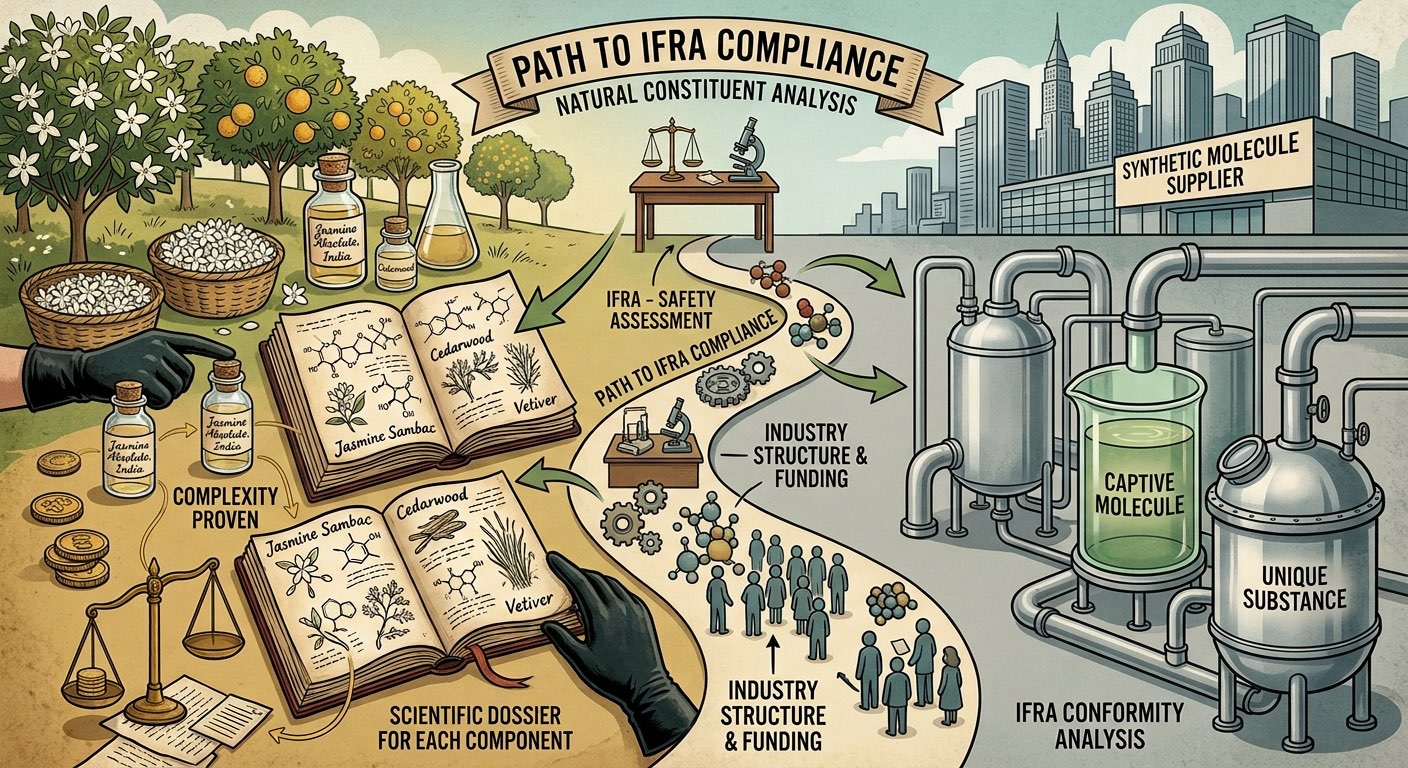
A synthetic molecule is one substance: one dossier, one set of studies, one entry in the standard. A natural extract is a mixture, and the system does not assess “jasmine”, it assesses its constituents. Each restricted sensitiser inside pulls the whole extract’s usable ceiling down.
So the cost of proving a material safe scales with how many things are inside it, and naturals are the most complex things in the palette. Nobody had to conspire for that to be true. But the consequence is commercial: a house formulating with single molecules absorbs a new amendment by swapping an ingredient, while a house formulating with absolutes reworks the structure or drops the material. The same rule is an inconvenience on one side and an existential question on the other, as it was for oakmoss and is again now that the EU allergen list has gone from 26 substances to 82, 28 of them natural extracts.
Jasmine absolute is an open market. Captives are not
This is the part that gives the arithmetic its weight. Jasmine absolute has dozens of possible suppliers, from Grasse to Egypt to India, and a buyer can go straight to a distiller. Nobody owns jasmine.
Captive molecules work the opposite way: developed, patented and produced exclusively by a single composition house, and unavailable to anyone else for the life of the patent. Several of the molecules that defined whole eras of modern perfumery are captives of this kind. The largest producers spend several hundred million euros a year on that research and on the regulatory clearance those molecules require (ScentXplore). A distiller cannot fund that work for an absolute.
Every gram that moves from a natural to a synthetic therefore moves from an open market with many independent sellers to a closed one with a handful. And those few are the same companies that fund the association authoring the standards. That requires no bad faith from anyone. It is what the structure produces, which is precisely why the conflict of interest is worth naming even with no wrongdoing to allege.
Who writes IFRA standards, and what the lobbying shows
IFRA is not a regulator. It is the industry’s own association, head office in Geneva, operations centre in Brussels, at the door of the institution that writes European chemicals law. It is funded directly by its Regular Members, the handful of multinational flavour and fragrance producers that dominate the sector (IFRA). The science comes from RIFM, the industry’s research institute, whose findings IFRA states are reviewed by an independent expert panel with no industry ties.
Now the part that cuts against the easy story. IFRA has declared EU lobbying costs between roughly €100,000 and €700,000 a year depending on the year, and the individual producers that register in Brussels declare sums of the same order (LobbyFacts). For this industry those are unremarkable sums. Plenty of Brussels trade bodies spend an order of magnitude more.
Which is the point. The leverage was never the lobbying budget. It is that the industry authors the standard, and the standard’s method, prove every constituent, prices complexity. You do not need to lobby for what the structure delivers by itself.
The pickaxe seller: who profits from reformulation
The trade saying is that in a gold rush the pickaxe seller does better than the prospector, and the reported numbers bear it out. At the largest producer, the fragrance and beauty division grew 7.9% like-for-like in 2025 with fine fragrance up 18.3%, resilience analysts attribute partly to exposure to regional and niche brands growing 30% to 35% a year (Personal Care Insights).
The mechanism is worth stating exactly, because it is not a story about a collapsing market. What is growing is the number of new fragrance brands, and most of them are not perfumers. Most fine fragrance, niche included, is composed by a handful of ingredient houses and licensed to the label on the bottle, with the perfumer employed by the supplier rather than by the brand whose name is on the flacon (Delacourte). Every new house that cannot formulate is a new client.
So the suppliers grow on the proliferation itself, while the independent brands driving that proliferation are the ones losing momentum. The pickaxe seller is indifferent to which prospector strikes gold.
What IFRA compliance now costs a naturals buyer
Regulatory documentation is now part of a material’s price rather than an administrative afterthought. A supplier who can hand over a constituent-level allergen breakdown per batch is selling something materially different from one who can only certify origin, and that gap widens with every amendment.
The question to ask a supplier is no longer only what the material costs. It is who paid to prove it can be used, and whether that work travels with the batch.
Source: Death by jasmine: why organic perfumery is under threat - The Ecologist
Was this useful?
What was missing?
Noted, thank you. It goes straight to the editorial side.