Sustainable fragrance: CITES, traceability, and who pays
By the LiaKea Beauty Tribe editorial team7 min read
A perspective published this year in RSC Sustainability proposes something this industry has never really had: one grid to score itself against, the same grid for everybody. The paper is signed by Kristina Plevova and Sylvain Antoniotti of the Institut de Chimie de Nice (CNRS, Université Côte d’Azur), Stella Antoniotti of Bayes Business School in London, and Alain Frix of Allchemix in Belgium. Antoniotti also sits at the university’s fragrance, flavour and cosmetics innovation institute in Grasse, which is worth stating plainly: this is not an outsider’s critique of perfumery, it comes from inside its own territory.
Their starting point is generous to the trade. The industry took up natural sourcing and green chemistry early, before either had a name, and what has changed is not the intention but the level of proof now demanded. Competition, regulation and consumer expectation call, in their words, for “a sincere and substantial implementation of sustainability across every dimension” of the business.
What the SDG grid asks of R&D and production
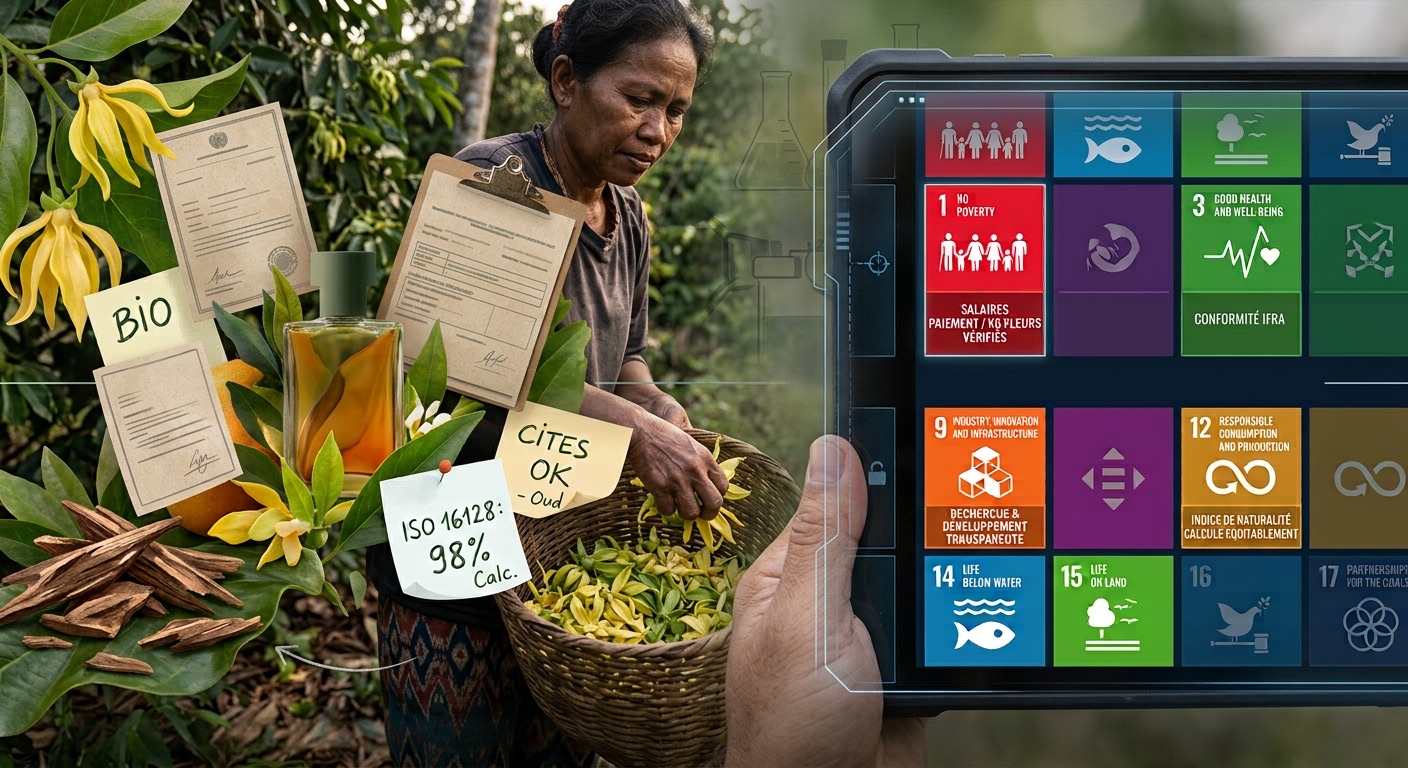
The proposal is integrated in the strict sense of the word: stop treating sustainability as a portfolio of separate initiatives, and run research, innovation and production against a single grid, the seventeen United Nations Sustainable Development Goals. Four are addressed head-on: goal 1, no poverty; goal 3, good health and well-being; goal 9, industry, innovation and infrastructure; goal 12, responsible consumption and production. Six more are named as indirect beneficiaries: clean water, clean energy, decent work, climate, life below water and life on land.
That is more than vocabulary, and it deserves credit before it gets an objection. “Sustainable” as a mood cannot be contradicted, because it asserts nothing. A goal number can. Naming which goal a claim serves turns a feeling into a statement that somebody else can go and check, and it makes two projects comparable that would otherwise both be described as good.
Which is exactly where the caution comes in, because this industry has done this before. Naturalness was a mood until ISO 16128 gave it an arithmetic, and the arithmetic promptly became the thing to optimise: a percentage that arrives on the brief as a target rather than as a result, computed on whichever basis reaches the figure already printed in the deck. A grid does not fix that on its own. A grid is a way of counting, and the question that decides whether counting helps is never the grid, it is who produces the numbers.
What a CITES permit on agarwood actually proves
In this trade, the answer is usually: the party being scored, or its supplier.
Take goal 15, life on land, and the material where it bites hardest. Aquilaria and Gyrinops, the genera that produce agarwood, are listed under CITES Appendix II, so a permit accompanies the wood or the oil at every border between the forest and the buyer. That certificate is the entire legal basis of the trade, and on a sustainability grid it reads as a fact: permit present, goal 15 satisfied, next line.
We have refused oud lots whose CITES documentation was fabricated, coming through the Pakistani chain. The paperwork was there. It was worth nothing. Nothing in a scoring framework distinguishes those two lots, because both arrive with a certificate attached, and the only thing that separated them was somebody upstream deciding to look hard at the document rather than file it.
Why traceability costs more on naturals, and who it excludes
The obvious answer to a forged certificate is more certificates: deeper traceability, documentation per batch, an audit trail that runs back to the plot. This is where a scoring grid quietly turns into an industrial policy, because the cost of proof does not fall evenly on the people asked to produce it.
Naturals are the hard case, structurally. A synthetic molecule has one plant, one process, one batch record, and its traceability is close to free because it was already being written for other reasons. A natural has a season, a region, weather, and often a great many smallholders delivering to a single still, where the material is pooled long before anyone thinks about paperwork. Documenting that is not a formality laid on top of the work, it is a second job, and it costs more per kilo the fewer kilos it is spread across.
So the requirement selects, and it selects on size rather than on practice. A chain that is three years old and still learning its own yields has no compliance officer and cannot fund one out of a few hundred kilos. Neither can a good smallholder distiller. As buyers we meet this from the other side: past a certain level of documentation, we can no longer work with the small producer at all, not because the material is worse, but because the file is missing. And the file is not the practice. The producer who cannot assemble a dossier is sometimes the one whose way of working would survive the closest look, while the operation that scores well is sometimes just the one that could afford to be measured. Pushed far enough, a sustainability grid becomes a consolidation mechanism: it points at the actors large enough to carry the apparatus of proof, and scores out the artisanal end of the trade for reasons that have nothing to do with what that end does to the land.
There is a way through it, and it is not a general one. We absorb the work downstream instead of demanding it upstream: we rectify the oils ourselves and run the IFRA compliance on the whole concentrate, rather than ask a smallholder for a per-batch allergen dossier they have no means of producing. That holds at our scale, where the buyer has the lab and the will to use it. It does not scale to an industry, and nothing in a grid rewards it.
What an ylang-ylang picker is paid per kilo of flowers
Goal 1 is the elimination of poverty. Applied to a natural raw material, it resolves to one arithmetic: what the picker is paid per kilo of flowers, how many kilos she gathers in a morning, and what share of the distillery-gate price that represents.
Almost nobody publishes that calculation, because almost nobody holds both ends of it. Our own piece on Comorian ylang currently says that field investigations document very low daily wages, which is precisely the kind of sentence a grid cannot score: it is true, it is unfalsifiable, and it commits no one. We hold both ends of that calculation, for the Comoros and for Madagascar, before and after the 2020 collapse. The next article in this series will publish it, in euros per kilo of flowers and in euros per day.
What this series will test, from ylang prices to IFRA
Over the next pieces we will take the goals the perspective names and put each one against the field. Goal 1 at the farm gate, with the ylang numbers. Goal 12 against the accounting of naturalness. Goal 9 against the question of who ends up owning the molecule that replaces a natural. Goal 3 against the allergen and IFRA restrictions that already govern the palette. Goals 14 and 15 against persistence in water and the paperwork that guards a forest.
The frame the authors propose is the right one, and the industry has nothing better on offer. The work it leaves undone is the part that decides everything, and it cuts both ways. A grid scores what it is shown, and here what it is shown is supplied by the party being scored: demand too little proof and a forged permit passes, demand too much and proof becomes an entry fee that only the largest can pay.
So the two questions we will carry through this series, goal by goal, are these. Which of these objectives can still be verified by someone who did not write the certificate. And who gets pushed out of the trade by the verifying.
Source: A holistic vision for a sustainable fragrance industry - RSC Sustainability
Was this useful?
What was missing?
Noted, thank you. It goes straight to the editorial side.