What a CITES permit on agarwood proves
By the LiaKea Beauty Tribe editorial team6 min read
Key figures
- Wild share, by Aquilaria species, 2010 to 2020
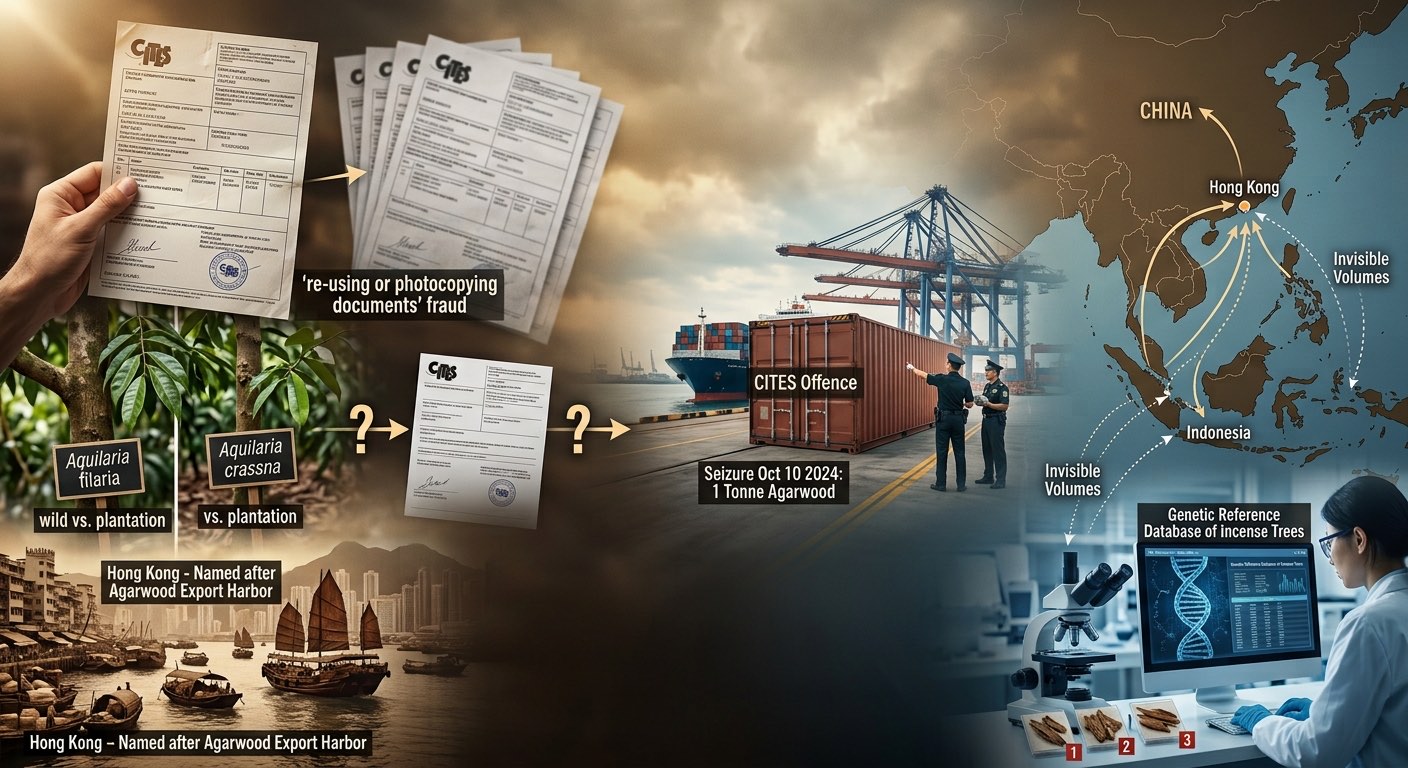
About 97% of Aquilaria filaria and 57% of A. malaccensis came from wild sources, against more than 99% of A. crassna from plantations
As of
- Hong Kong seizure, described as the largest in two decades
About 1 tonne of scheduled agarwood, estimated value HK$18 million, in a 20-foot container arriving from Nansha. Maximum penalty HK$10 million and 10 years
As of
- Illegal felling of Hong Kong's own incense trees
Reported to have risen twelvefold in 2023 against the previous year, with more than 20 trees cut in a single night. Highest grades fetch up to $10,000 a kilo
As of
We have been handed CITES certificates that were photographs of photocopies of photocopies. Nothing on them could be checked properly: not the stamp, not the signature, not whether the same sheet had already travelled with another shipment.
The instinctive reading is that this is a supplier problem, the kind of sloppiness you walk away from. It is not. It is a documented category of abuse, in a system that offers the buyer no way to do better.
Photocopying a CITES permit is a listed method of fraud
TRAFFIC’s brief on corruption in CITES documentation lists the forms of document abuse found across a decade of seizure records. One of them is exactly this: “re-using or photocopying documents: the same permit is used multiple times or duplicated” (TRAFFIC, March 2020, Willow Outhwaite).
The same brief explains why a copy travels so easily. “Often all that is needed to make a shipment of illegal wildlife appear legal is documentation, which may be a piece of paper in a non-standard format. Once exported with seemingly correct documents, importing countries are very unlikely to challenge the legality of a shipment, often fearing the repercussions of questioning the integrity of the issuing authority.”
A buyer defeated by the document is therefore not being careless. There is no central register of CITES permits to check a number against in real time. That gap is the reason the CITES Secretariat and UNCTAD run the eCITES programme, which replaces paper with verifiable electronic permits, country by country.
Why the species decides: Aquilaria filaria against crassna
Agarwood is not one supply. Analysing global trade data over 2010 to 2020, Lai, Zhang, Yang and Gale found that roughly 97% of traded Aquilaria filaria and 57% of A. malaccensis came from wild sources, while more than 99% of A. crassna came from plantations (Global Ecology and Conservation, 2025, reported by Mongabay).
Same genus, same appendix, same paperwork, three different answers to the only question a serious buyer has. A document that says agarwood says nothing. A document naming the species says most of it.
And the field that carries the distinction is the one most likely to be wrong. Falsely declaring the source is, in TRAFFIC’s data, a common form of abuse: specimens “are stated to be captive-bred when they are, in fact, wild caught”. The plant version is documented too, wild-harvested orchids laundered through commercial greenhouses in Thailand and Malaysia, then exported to Singapore under CITES permits describing them as artificially propagated.
Hong Kong is named after an agarwood export harbour
Which brings us to where so much of this material passes, and why that is not an accident of shipping lanes.
Incense trees, Aquilaria sinensis, were “planted in large numbers in Tung Koon (Dongguan) District and the New Territories of Hong Kong”. The product moved overland to Tsim Sha Tsui, then by sampan to Shek Pai Wan, today’s Aberdeen, “where incense products were finally exported to destinations in the Chinese mainland, Southeast Asia and places as far as Arabia”. That harbour was named Fragrant Harbour, and, in the words of the territory’s own herbarium, “the whole island was later known as Hong Kong” (Hong Kong Herbarium).
The city is named after an agarwood export terminal. The trade did not choose Hong Kong; Hong Kong is what the trade built.
Why a container from Nansha is a CITES offence in Hong Kong
The modern version rests on three things, and none of them is romantic.
First, Hong Kong administers CITES itself. The Protection of Endangered Species of Animals and Plants Ordinance, Cap. 586, is enforced by the Agriculture, Fisheries and Conservation Department, and it requires a licence issued in advance to “import, introduce from the sea, export, re-export or possess” a listed species (GovHK). Re-export is named explicitly, which is the point for a port whose business is goods that do not stay.
Second, the boundary with the mainland is a permit boundary. That is why the seizure of 10 October 2024, about one tonne of scheduled agarwood with an estimated value of HK$18 million, was an offence rather than domestic freight: the 20-foot container had arrived from Nansha, in Guangdong (Hong Kong Government). The penalty runs to HK$10 million and ten years. Trade press described it as the largest haul in two decades (Premium Beauty News).
Third, and least intuitive: Hong Kong is one of the few places where the paperwork and the freight actually agree. The trade-data study found CITES and customs records to be consistent for Hong Kong, India, Singapore and Thailand, while significant volumes moving from Indonesia to Africa appear in customs records with no matching CITES entry at all.
That last point deserves care, because it cuts against the obvious reading. Hong Kong looks like a hotspot partly because Hong Kong counts. A jurisdiction that licenses re-export, publishes its seizures and reconciles its records will always look busier than one that does neither. The volumes nobody can see are the ones with no permit trail to compare.
Hong Kong’s own incense trees, felled twelvefold in 2023
The city is not only a corridor, it is a source being drained. Illegal felling of incense trees in Hong Kong rose twelvefold in 2023 against the previous year, and researchers describe more than twenty trees cut down in a single night. The highest grades fetch up to $10,000 a kilo (Premium Beauty News).
A territory that gave the material its name is now watching its own protected trees leave in the same direction as everyone else’s.
What a DNA reference database does that a permit cannot
The response taking shape in Hong Kong is worth noting, because it does not involve better paper. Researchers led by Zhang Huarong, at Kadoorie Farm and Botanic Garden, are building a genetic database of the territory’s incense trees, with distinct genetic groups by area, so that seized agarwood can be cross-referenced against the protected trees it may have come from.
That is a different theory of proof. A permit asserts what a document says about a shipment. A genetic reference asks the material itself. Zhang is also a co-author of the trade-data study above, which is fitting: the same work that found the gaps in the permit record is building the thing that does not depend on it.
4 questions to ask an agarwood supplier before the permit
- Which species? filaria, malaccensis and crassna carry different odds of being wild, and the answer belongs on the document, not in an email.
- Plantation or wild, and who else says so? This is the most misdeclared field in the system, so a second source matters more here than anywhere.
- Can I see the permit as issued, not as forwarded? A photograph of a copy cannot be verified. Asking for the original is a commercial request, not an accusation.
- Does the exporting country issue electronically? An eCITES permit with a verifiable code settles in seconds what a paper chain never settles.
None of this turns a buyer into an enforcement authority. It moves the question off a document nobody can verify and onto a fact the supplier either knows or does not, the same test that applies to oud sourcing generally and to sandalwood in India.
Source: Addressing corruption in CITES documentation processes - TRAFFIC
Was this useful?
What was missing?
Noted, thank you. It goes straight to the editorial side.