Madagascar cloves: why the cyclone damage lasts years
By the LiaKea Beauty Tribe editorial team5 min read
Key figures
- Clove export volume, Madagascar, 2025
Clove export volume fell 49.4% while prices rose 7%, for a 45.9% drop in revenue. The central bank blames cyclones and climate disruption that limited flowering
As of
- Recovery after a cyclone
A clove tree fully stripped of its leaves by a violent storm only starts producing again after three to five years, and some trees are uprooted and die
As of
- Madagascar clove production, 2022
Production rose from 16,021 t in 2020 to 34,867 t in 2022, worth about $224 million, making Madagascar the world's first clove exporter
As of
Madagascar clove has become very hard to source. That is not a reading of the export statistics. It is what sourcers and people working close to the cooperatives told us directly: they can no longer source clove, and they do not expect that to change soon. The plantations have been damaged by successive climate events, and some of them are now trying to grow clove in other zones, less exposed to cyclones.
That last detail says more than any figure. Nobody moves a tree crop that takes ten years to come into full bearing because of one bad season.
The statistics say the same thing, after the fact.
How much clove Madagascar supplies, and from where
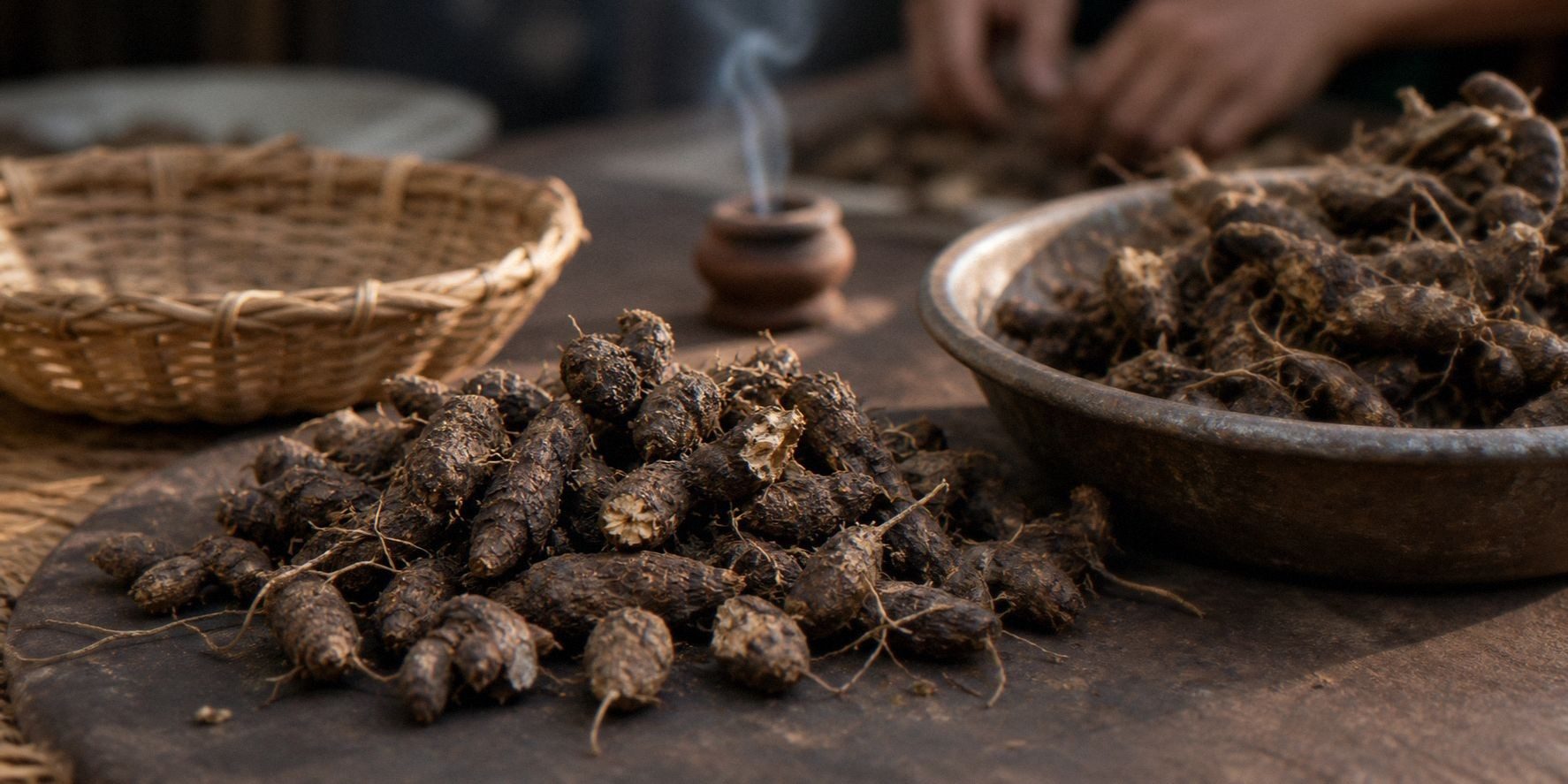
Madagascar became the world’s first clove exporter in 2022. Production climbed from 16,021 tonnes in 2020 to 34,867 tonnes in 2022, worth about $224 million, according to figures reported by L’Express de Madagascar. Around 18,000 planters work the crop.
It is also one of the most geographically concentrated supplies in the spice trade. About 90% of Malagasy clove grows in a single region, Analanjirofo, on the north-east coast, the stretch of coastline the cyclone track crosses most often. Indonesia grows far more, but consumes most of its own crop in kretek cigarettes, which leaves Madagascar, Tanzania and the Comoros carrying the export market.
What the cyclones did to Madagascar clove exports
The decline came in two steps. In 2024 export revenue fell 35.5%, with lower volumes and an average price down to about $6 a kilo; the press attributed part of it to unfavourable weather that year, the year Cyclone Gamane hit Analanjirofo in March. In 2025 export volume fell 49.4%, prices rose 7%, and revenue dropped 45.9%. The central bank’s explanation is unambiguous: the fall is “imputable aux épisodes cycloniques, ainsi qu’aux bouleversements climatiques en général, qui ont limité la floraison”.
Then, in February 2026, Cyclone Gezani made landfall near Toamasina and swept through Analanjirofo again, two weeks after Cyclone Fytia.
The price rise is the detail worth noticing. Volume halved and price barely moved up. That is not a market rationing a scarce product, it is a supply that physically is not there.
Why a clove tree takes years to recover from a cyclone
This is the part that makes the shortage durable rather than seasonal, and it is agronomy, not market sentiment.
A clove tree has shallow roots, dense foliage and brittle wood, which is exactly the wrong architecture for a cyclone coast. After a violent storm, the tree is stripped bare and only starts producing again after three to five years; some are uprooted and die outright. That figure comes from an adaptation study on Analanjirofo published by Canada’s IDRC, and it means a 2026 storm is still in the 2029 harvest.
Replacing a lost tree is slower still. CIRAD’s historical work on the crop puts first fruiting at five to six years, a first normal harvest at eight to ten, and full production around twenty. Flowering is irregular even on healthy trees, with a good crop roughly every three years.
None of this is new. The same CIRAD analysis records national output falling from 13,540 tonnes to 920 tonnes between 1967 and 1968 after cyclones hit at harvest time. What has changed is the frequency of the storms relative to the time the trees need between them.
Clove leaf oil and clove bud oil draw on the same weakened trees
For a perfumery or flavour buyer, the spice figures understate the problem, because the oils come from the same orchard.
Clove bud oil is distilled from the dried buds, the spice itself, at 11 to 13% yield. Clove leaf oil, the main source of natural eugenol, comes from leaves and twigs at about 2%, which means roughly 60 kilos of foliage per litre. Those leaves are harvested by cutting the outer branches and the crown, one to four times a year.
CIRAD documented what that does over time. Of about 77,000 hectares of clove surveyed in 2005, only 37,000 were still producing buds; the rest had become unproductive through excessive leaf cutting for distillation. A tree cut for leaves is a tree that flowers less, and a tree already stripped by a cyclone is a tree that has nothing left to cut.
So the two products compete for one damaged, ageing resource. When the buds fail, the leaves are the only income left on the tree, and cutting them delays the recovery of the buds.
What a Madagascar clove buyer should plan for
Treat this as a multi-year constraint, not a bad season. A tree stripped in February 2026 bears again around 2029 at best. Contracts and formulas built on a quick rebound are built on the wrong timescale.
Separate bud, leaf and stem oil in your planning. They come from the same trees but respond differently to stress, and a leaf oil that stays available may be available precisely because trees are being cut harder.
Ask what replanting is behind the lot, and where. The orchard is old and little of it has been replanted. The sourcers who are now planting outside the cyclone belt are buying supply for the next decade; a supplier who does not replant is selling down a shrinking stock. New zones also mean new trees, so the first normal harvests from them are eight to ten years out.
Read eugenol price signals carefully. Natural eugenol from leaf oil and synthetic eugenol are interchangeable on a spec sheet, not on a naturalness claim. A tight clove leaf market is the moment that difference starts to cost money.
Source: Exportation de girofle : chute de près de 50% du volume - Les Nouvelles
Was this useful?
What was missing?
Noted, thank you. It goes straight to the editorial side.