Why organic Madagascar ginger oil is so hard to find
By the LiaKea Beauty Tribe editorial team5 min read
Key figures
- Mitsinjo cooperative, Fairtrade ginger, 2022
The Mitsinjo cooperative, 378 producers, 100% organic and Fairtrade certified since 2014, produced 31.9 tonnes of Fairtrade ginger in 2022
As of
- Ginger essential oil yield
Steam distillation of dried ginger rhizome yields about 1.5 to 3% essential oil; fresh rhizome yields far less, around 0.3% on one Malagasy supplier sheet
As of
- Neonicotinoid residues in ginger extracts
A 2024 Chinese study found thiamethoxam, imidacloprid and clothianidin in 52 to 58% of the ginger essential oil and oleoresin samples tested
As of
Organic ginger from Madagascar is very hard to find. Its essential oil is harder still. Certified supply barely exists outside a few chains, and one of the people running such a chain is now thinking of leaving it.
A sourcer and exporter of Malagasy ginger told us he is hesitating to drop organic certification altogether. The reason is not the cost of the label. It is that there are too many pesticide contaminations for him to keep guaranteeing it. And that is before the fertilisers, which in his experience degrade both the quality of the ginger and its essential oil yield.
Behind that is a contradiction. Ginger is planted in zones where it also does the job of holding the soil. And it is a crop that runs on a lot of inputs.
Where ginger grows in Madagascar, and how much
Ginger is a small crop in Madagascar, grown on the central highlands and the east coast, mostly by smallholders on small plots. L’Express de Madagascar describes it as an expanding cash crop, with yields of 10 to 20 tonnes a hectare. National statistics are thin enough that one academic survey notes the agriculture ministry holds no data on it at all.
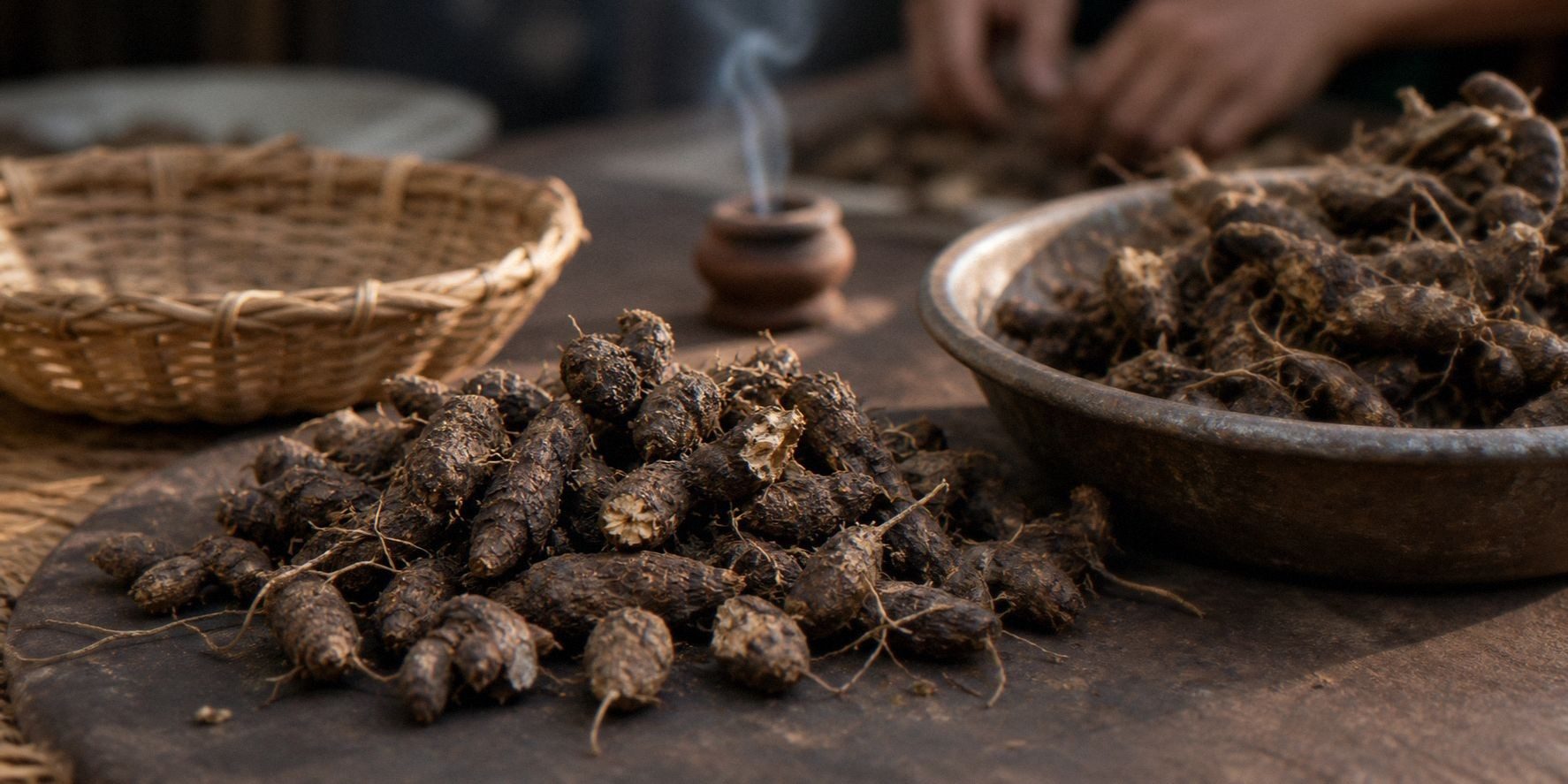
The organised supply is easy to list because it is short. The Mitsinjo cooperative, 378 producers, has been Fairtrade certified since 2014 and is entirely organic; it produced 31.9 tonnes of Fairtrade ginger in 2022. A few exporters, among them Phael Flor, sell Ecocert-certified organic ginger to the EU and US. Biolandes distils an essential oil and an oleoresin from dried ginger of the eastern-central region, without an organic claim. In 2023 the mining company Ambatovy started supporting 137 growers around Moramanga with seed rhizomes and organic fertiliser, but the output is not certified.
That is roughly the landscape. For an essential oil buyer it narrows further, because organic oil needs both a certified rhizome and a certified distillation behind it.
Ginger on the slopes: holding soil, consuming inputs
The zones where ginger is planted are zones where it is also asked to stabilise the ground. That is the reason it is there, and it is a good reason.
But the crop itself is demanding. Ginger is a heavy feeder: a typical agronomic recommendation in India is 120 kg of nitrogen, 80 of phosphorus and 80 of potassium per hectare. It is also exposed to two diseases that can wipe out a plot. Soft rot, caused by Pythium, is the main yield-limiting disease worldwide, and its standard control relies on treating seed rhizomes and on copper fungicides. Bacterial wilt, caused by Ralstonia, has been endemic in Madagascar since at least 1936 and is especially diverse on the highlands, where potato and tomato, both hosts, are common rotation crops.
The soil-holding role also depends on how the crop is managed. Ginger is a rhizome that is lifted at harvest, so the ground is bared and disturbed every year. A trial in the hills of Bangladesh measured the highest annual soil loss of four crops under ginger, 22.7 tonnes a hectare. Grown under shade or with permanent cover, the picture changes. Grown bare, it is the opposite of what the slope needs.
Why organic ginger supply stays scarce in Madagascar
Put those two facts together and organic ginger stops being surprising. A grower who drops the inputs on a heavy-feeding, disease-prone crop accepts real losses, on land that is often already marginal. The Mitsinjo cooperative states the risk plainly: organic ginger is “particularly vulnerable to heavy rains in the rainy season”. In 2019 and 2020 it had to finance 20 tonnes of organic seed ginger itself, because certified planting material is part of what is missing.
Conversion takes years, certification has a cost, and the premium arrives only if a buyer is lined up. For a smallholder with a plot of ginger on a slope, the conventional route is the rational one.
Why the organic status matters for ginger essential oil
For a perfumer or an aromatherapy brand, it would be tempting to treat the organic label as a marketing layer on top of the oil. It is more than that.
Distillation concentrates what is in the rhizome. A 2024 Chinese study found the neonicotinoids thiamethoxam, imidacloprid and clothianidin in 52 to 58% of the ginger essential oil and oleoresin samples tested. Residues do not stay in the field; they follow the material into the extract. That is exactly the exporter’s problem: a contamination found on the rhizome is a contamination in the oil, and a certificate he can no longer stand behind.
The yields make the arithmetic harder. Dried ginger gives about 1.5 to 3% essential oil by steam distillation, and fresh rhizome much less, around 0.3% on one Malagasy supplier sheet, roughly 360 kilos of fresh ginger per kilo of oil. Every kilo of certified oil needs a large mass of certified rhizome, from a supply that is already scarce. And the inputs cut both ways: the same exporter finds that fertilised ginger gives a lower oil yield and a poorer quality, so the conventional route does not even buy the distiller more oil.
What an organic ginger oil buyer can do with Madagascar
Expect to build the supply rather than find it. The certified volume is small and largely spoken for. A durable source means working with a cooperative or exporter before the planting season, not after the harvest.
Ask for the certificate of the rhizome and of the distillation, separately. A certified distiller working on uncertified ginger does not produce organic oil.
Test for residues, organic or not. The Chinese data shows the risk is real for ginger extracts in general, and a residue analysis costs less than a recall.
Ask how the ginger is grown on the slope. Shade, cover and rotation decide whether the crop holds the soil it was planted to hold, and they are also what makes an organic yield viable.
Source: Profil producteur : Mitsinjo, épices - Max Havelaar France
Was this useful?
What was missing?
Noted, thank you. It goes straight to the editorial side.