Lavender or lavandin: what the yields decide
By the LiaKea Beauty Tribe editorial team6 min read
Key figures
- Oil yield per hectare
About 20 kg of essential oil per hectare for true lavender, around 40 for the Diva Essence clone, and 150 to 200 for lavandin
As of
- Share of lavandin on the Plateau de Valensole
Lavandin represents 90% to 95% of cultivated fields there
As of
- Heatwave yield loss, and what it costs
A loss of that order is absorbed on lavandin and not on true lavender, where fixed costs per hectare are spread over roughly eight times less oil
As of
- Productive life of a field
Fields stay productive for around six years, longer depending on disease pressure, weather and planting year
As of
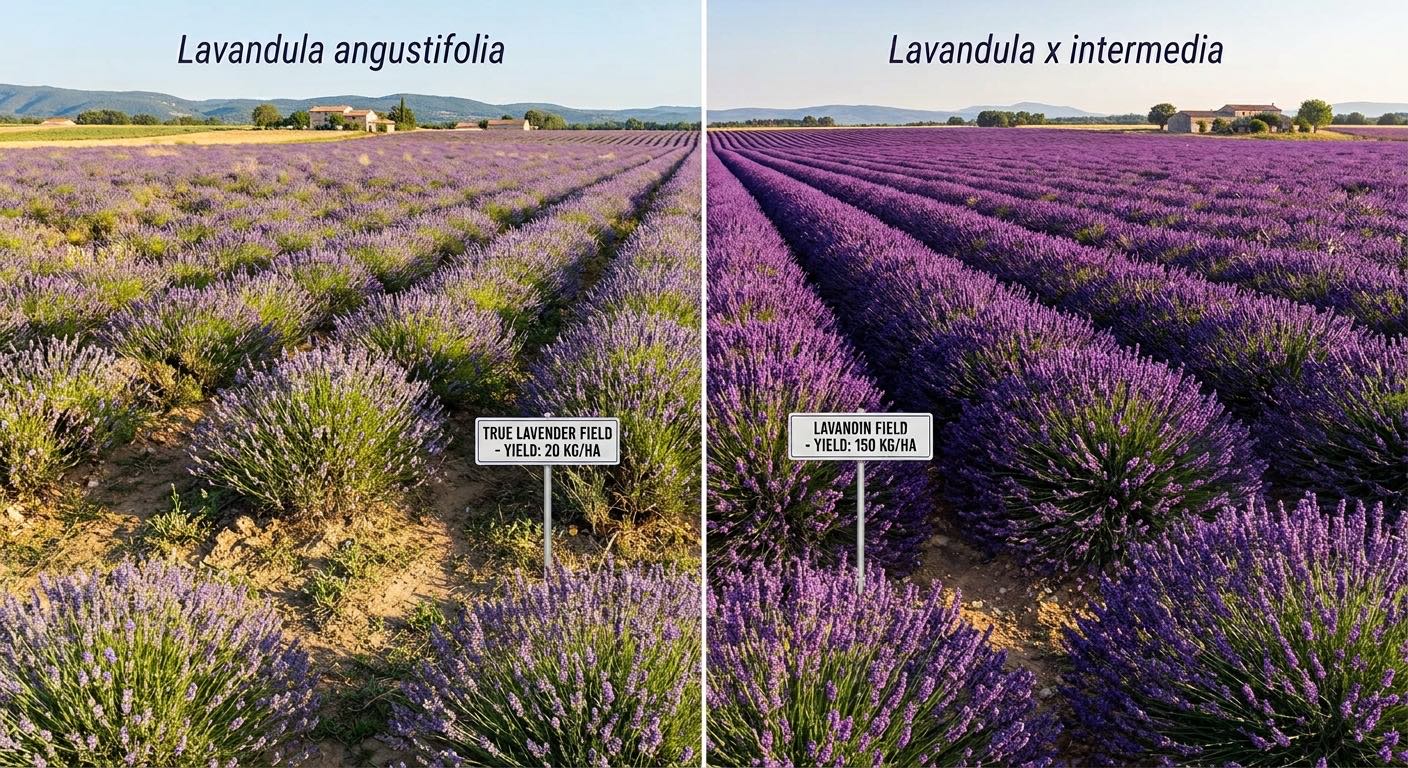
The photograph everyone has seen of Provence, rows of purple running to the horizon on the Plateau de Valensole, is mostly not lavender. Between 90% and 95% of those fields are lavandin.
That is not a marketing substitution. It is arithmetic, and the numbers are public.
20 kg against 150: the yield gap that decides the field
A hectare of true lavender gives about 20 kg of essential oil. The same hectare of lavandin gives 150 to 200 kg. The Diva Essence clone, a selected true lavender, roughly doubles the true lavender figure to about 40 kg and still sits far below lavandin.
These figures come from dsm-firmenich’s press visit to the Plateau d’Albion this summer, led by a producer and member of the SCA3P cooperative (Premium Beauty News).
Eight times the oil from the same ground, the same water, the same harvest pass. No agricultural decision survives a ratio like that unless the price difference compensates it, and for most industrial uses it does not: lavandin goes into detergents, soaps and functional fragrance in volumes that true lavender could never supply at a viable price.
So the two plants are not competitors sold on quality. They occupy different markets, and the field allocation follows.
Why a lavandin field commits the ground for six years
A lavender or lavandin field stays productive for about six years, sometimes considerably longer depending on disease pressure, weather and the planting year.
That is the number a buyer should hold onto, because it sets the response time of the whole supply. A producer choosing what to plant is committing that ground for most of a decade against prices nobody can forecast that far out. When the market turns, the crop cannot follow: the plants in the ground were decided years earlier, and pulling them early means writing off the establishment cost.
It is the same structural slowness that governs ylang-ylang in the Comoros and, at a far longer horizon, sandalwood in India. Perennial crops do not respond to price signals, they respond to price signals from six years ago.
What SCA3P’s quarter of world lavandin means for a buyer
One cooperative, SCA3P, accounts for more than a quarter of global lavandin production, working with around 200 producers and some 50 distilleries.
Concentration of that order is worth naming because it cuts two ways. It makes the material traceable and documented at a level most naturals never reach: a defined membership, known distilleries, a single interlocutor able to answer on volumes. That is exactly what the allergen documentation chain now demands.
It also means a buyer negotiating lavandin is, statistically, negotiating with one of a small number of counterparties, and that the weather over one French plateau moves a quarter of world supply. Diversification of origin, the standard answer elsewhere, is barely available here.
What heat waves do to lavender yields in Provence
Climate pressure is reshaping the balance, with heat waves weighing on yields and pushing producers to adapt practices. In the field the loss runs on the order of 10% to 20% in a bad year, and that percentage does not land evenly on the two crops.
The reason is that the costs per hectare barely move. Establishing the field, the harvest pass, the distillation run: these are much the same whether the hectare gives a lot of oil or a little. So the cost per kilo of oil is a fixed number divided by the yield, and when the yield falls the two crops fall from very different heights.
Lavandin losing a fifth still has 120 to 160 kg per hectare to carry those costs. True lavender losing a fifth drops from about 20 kg to about 16, and 16 kg is not far from the point where the hectare stops paying for itself at all.
The end of that arithmetic is visible in the south of France: some spike lavender, Lavandula latifolia, has in some years simply not been harvested. Not sold cheap, not stockpiled. Left standing, because the crop no longer covered the cost of going to get it.
There is an irony worth naming. Spike lavender is one of lavandin’s two parents, crossed with Lavandula angustifolia to produce the hybrid. The hybrid now outyields both parents by enough that one of them is being abandoned in the field.
The adaptation levers are slow. Clone selection, planting density, altitude. Diva Essence is an example of the first, doubling true lavender yield, and it took years of selection to arrive. Which means the yield figures in this article are not fixed points but the current state of a moving system, and the gap between true lavender and lavandin is the thing to watch: if heat compresses true lavender further, the case for planting it at all gets harder in exactly the region whose name sells the material.
Why some lavender sells below what lavender costs to make
Squeeze a crop that way and something gives. What gives, predictably, is the label.
The temptation to buy lavandin and sell it as lavender is strong, and it is the standard route in this material. The two plants are close relatives, the oils share their main constituents, and the price gap is wide enough to pay for the risk.
This is where a buyer gets a free detection tool, and it does not require a laboratory. When a lavender oil is offered below what true lavender costs to produce, that price is not a negotiating win. It is a statement about the composition. A producer who has spent a season on 20 kg per hectare cannot sell under cost for long, so a durable low price means the oil in the drum is not what the label says, or not only that.
The laboratory answer exists too, and it is worth specifying on a purchase order rather than assuming. ISO 3515 sets the ranges for Lavandula angustifolia, with linalool at 20% to 45% and linalyl acetate at 25% to 46% (Abouelela et al., Scientific Reports, 2026). The discriminating markers between lavender and lavandin are camphor first, then borneol, eucalyptol and a few others: true lavender carries very little camphor, lavandin carries markedly more. Read the current ceiling off the ISO text itself rather than from a trade summary, because that is exactly the number an adulterated lot is engineered to sit under.
None of this is new to anyone in the trade, and that is the point. The mechanism is understood, the analysis is available, and the practice persists because the price pressure described above is real. It belongs in the same family as a naturalness percentage that is mostly a statement about solvent: technically arguable, commercially convenient, and misleading to whoever reads only the label.
5 questions to ask when buying lavender oil
- Which species, on the certificate, not in the conversation. Lavandula angustifolia and Lavandula x intermedia are different materials at different prices, and “lavender” alone on a specification is not an answer.
- Which clone, for true lavender. Diva Essence and population lavender are not interchangeable in yield, and increasingly not in profile.
- Which plateau, and which year of the field. A field in its first or sixth year is not the same crop, and the region is small enough that the question is answerable.
- Whether the price is below the cost of production. If it is, that is a composition question, not a bargain, and camphor content is where it gets answered.
- What the cooperative can document per batch. Where concentration exists, use it: this is one of the few natural materials where constituent-level documentation is genuinely obtainable.
Source: Behind the scenes of Provence's lavender and lavandin harvest - Premium Beauty News
Was this useful?
What was missing?
Noted, thank you. It goes straight to the editorial side.