Ethically sourced perfume: who actually gets paid
By the LiaKea Beauty Tribe editorial team5 min read
Key figures
- Gowé project timeline
Initiated in 2024 by Amouage with Hamaé, CPL Aromas and Eden Ecosystem; fragrance launch planned for 2027
As of
- The village supply chain
Around 20 women in a village some 400 km north of Dakar have been selling their gowé harvest since 2021
As of
- What consumers say about ethical sourcing
79% think companies have a moral obligation on people and biodiversity in natural ingredient sourcing, but only 37% are confident companies act on it, and 70% trust a commitment more when independently verified (UEBT Biodiversity Barometer)
As of
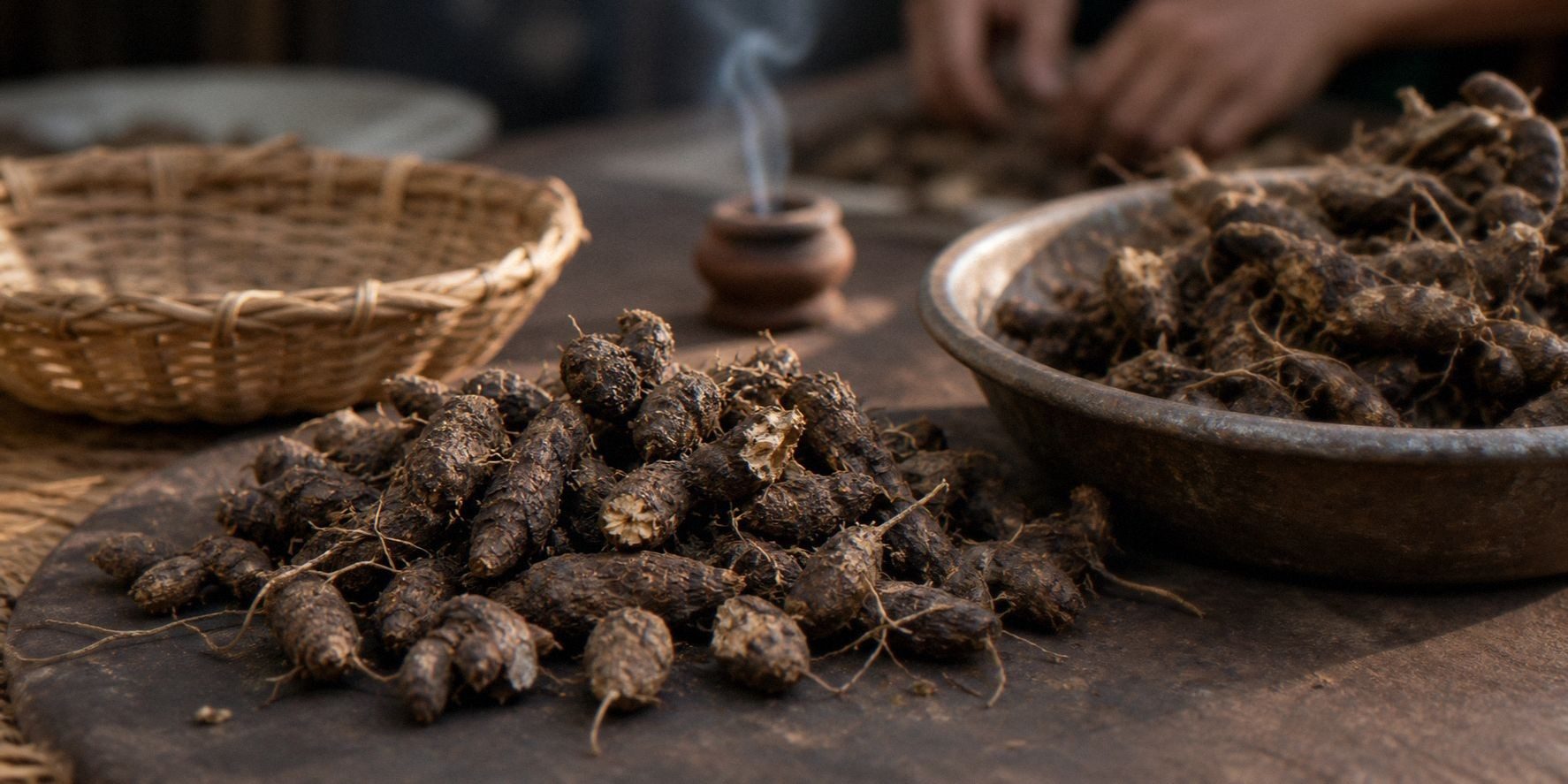
A root that West African women have burned, brewed and passed between generations is on its way into fine fragrance. Gowé, the tuber of Cyperus rotundus, is being turned into a perfumery extract through a project initiated in 2024 by Amouage with Hamaé, CPL Aromas and Eden Ecosystem, with a launch planned for 2027 (Nez). The industry language around this kind of arrival is almost always the same: a new ingredient, a discovery, an addition to the perfumer’s palette. That framing is worth pausing on, because it decides who gets treated as the author of the value.
Gowé in Senegal is not new, only its buyer is
In Senegal, gowé is not a novelty. It is one of the materials burned as thiouraye, the Wolof incense practice, and it circulates in feminine care rituals, infusions and household use. It is sold today by the bag on ordinary retail sites. The knowledge of how to lift, clean, burn, sort and dry the tuber without wrecking its scent is a local inheritance, transmitted between women rather than developed in a lab.
So the thing that is genuinely new here is not the material or the know-how. It is a buyer. That distinction sounds pedantic and is not: “discovery” language quietly relocates the origin of value from the community that built the practice to the company that industrialized its extraction. It is the same reflex that lets a supply chain be described from the brand backwards instead of from the field forwards, the pattern already visible in how little of the value from Comorian ylang-ylang reaches the pickers at the base of the chain.
Worth noting for anyone assuming the material was untouched by perfumery until a major house arrived: Maya Njie, a Swedish-born, Gambian-rooted independent perfumer working out of London, built Aethi Opum around thiouraye, the Senegalese incense tradition gowé belongs to. It took the Sadakichi Award at the 12th Art & Olfaction Awards in Athens (Perfumer & Flavorist). Independent perfumery, often with direct personal ties to the origin, tends to get to these materials first and to describe them with fewer claims of invention.
What the Amouage and CPL Aromas gowé project commits to
Credit where it is due, because the structure described here is not the extractive default. Around twenty women in a village roughly 400 km north of Dakar harvest and process the gowé, selling to Hamaé, which supplies Eden Ecosystem, which produces the extract for CPL Aromas. The women have been selling their harvest since 2021, turning an occasional gesture into a paid activity. The partnership is described as designed with the harvesters at the front of it, and the supply chain is said to guarantee the village access to water and electricity (Grazia Middle East).
Those are meaningful commitments, more concrete than most sustainability copy. They are also, as published, declarative. Nothing in the public record so far says who audits them, on what schedule, what share of the final price returns to the village, what happens to the arrangement if the 2027 launch underperforms, or whether the traditional knowledge itself, not just the raw material, was treated as something requiring consent and compensation.
The Nagoya Protocol already answers these questions
This is not uncharted territory. Senegal is a party to the Nagoya Protocol, which makes access and benefit-sharing a legal question rather than a goodwill one. The protocol requires prior informed consent from the communities concerned, mutually agreed terms, and fair sharing of benefits arising from the use of genetic resources, and it explicitly extends to the traditional knowledge attached to those resources (CBD). A generations-old harvesting and processing technique is exactly that kind of knowledge.
Applying that lens turns vague praise into checkable questions. Was consent obtained at community level, documented, and on what terms? Is benefit-sharing indexed to volumes or to sales, or is it a fixed purchase price that leaves the upside entirely downstream? Are the water and electricity commitments contractual or reputational? None of these are accusations. They are the standard any buyer sourcing from a Nagoya party should expect to satisfy, and the questions a serious partner should welcome.
Why ethical sourcing is a commercial argument, not a moral one
The demand side has already moved. In UEBT’s Biodiversity Barometer, 79% of consumers say companies have a moral obligation to have a positive impact on people and biodiversity when sourcing natural ingredients, but only 37% feel confident companies genuinely act on it, and 70% say they trust a company more when its ethical sourcing commitment is verified by an independent organization (UEBT).
That gap between expectation and confidence is the whole opportunity. Consumers are not asking for better storytelling, they are discounting storytelling. Independent verification is what converts a claim into an asset, which is why the distinction between a certified claim and a marketing one matters as much here as it does for organic and ‘natural’ labels in Morocco’s rose sector.
What to watch on gowé between now and 2027
Gowé is a useful case precisely because it is unfinished. A launch scheduled for 2027 gives everyone, buyers, journalists, competitors, roughly a year and a half to see whether the announced structure holds up in documents rather than interviews. The things worth tracking are specific: whether an ABS agreement is published or referenced, whether a third-party certification such as UEBT appears alongside the launch, whether the harvesters are named as partners in the commercial communication or reduced to an origin story, and whether the price paid at village level moves when the retail price does.
For sourcing teams the transferable lesson is simpler. When a traditional ingredient enters the industrial palette, the reputational risk does not sit in the extraction technology, it sits in the paperwork nobody published. Ask for the ABS documentation early, treat traditional knowledge as an input requiring consent rather than a free narrative, and prefer partners who volunteer the audit trail before being asked. That discipline is becoming a purchasing requirement in its own right, alongside the allergen-level traceability the EU now demands of natural extracts.
Source: Smell Talks : Gowé, un parfum d'Afrique - Nez, le mouvement culturel olfactif
Was this useful?
What was missing?
Noted, thank you. It goes straight to the editorial side.