Mexican perfume brands built on local botany
By the LiaKea Beauty Tribe editorial team5 min read
Key figures
- The two anchor houses
Xinú (Mexico City, founded 2016) and Arquiste (founded 2011 by Mexico City-born architect Carlos Huber), both built with master perfumer Rodrigo Flores-Roux
As of
Every so often a market shows you your own thesis from the outside. This outlet’s premise is that origin, the specific place a material comes from, and the story attached to it, is where value accrues, and that whoever claims it captures more than whoever merely grows it. Mexico’s niche perfume houses are that premise made literal: they turned botanicals the global fragrance industry had quietly used for generations into luxury brands, simply by putting the origin at the center.
Xinú, and the insight that started Mexican niche perfumery
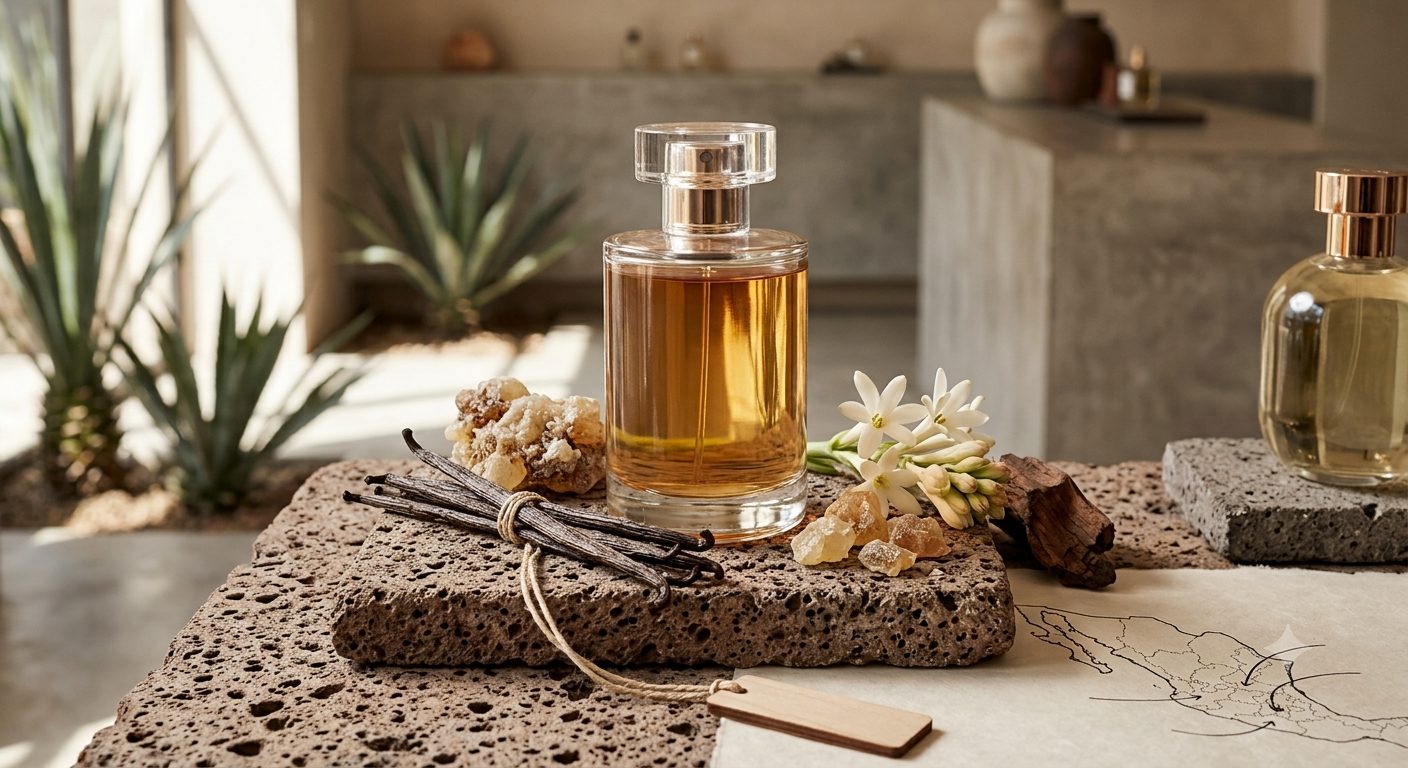
Xinú, the Mexico City house founded in 2016 by Verónica Peña, architect Ignacio Cadena and designer Héctor Esrawe, grew out of a single observation. Peña noticed that perfumes she admired around the world were built on ingredients native to Mexico, copal, vanilla, tuberose, marigold, yet Mexico had no luxury-perfume tradition of its own celebrating that abundance. The brand, named after the word for “nose” in the indigenous Otomí language, was the answer: fragrances built openly on Mexican botany, copal resin, agave, cedarwood, juniper, tobacco, orange blossom, palo santo, vetiver. Its Copāla scent is made from Mexican vanilla and copal, the same Papantla vanilla whose origin story Madagascar’s volume long overshadowed.
Arquiste, founded in 2011 by Mexico City-born architect and historic preservationist Carlos Huber, works a related seam: each fragrance reconstructs a precise historical moment, researched like a restoration project. Different method, same core move, treating provenance and narrative as the product, not the packaging. Tellingly, both houses were built with the same master perfumer, Rodrigo Flores-Roux, who mentored Huber, a single technical anchor under a scene that is otherwise young.
Xinú’s brand world, built by designers not marketers
What makes Xinú read as more than a fragrance line is that its universe is built by a designer-founder, not bolted on by a marketing team afterward. Its Juárez boutique, conceived by Esrawe Studio and Cadena Concepts inside a former car-repair shop reworked into a landscaped garden, is a radial wooden pavilion of narrow pillars and glass that dissolves the line between the shop and the plants outside (Dezeen, Surface). The detail that matters for this outlet is on the pavilion’s columns: each of the six signature perfumes is displayed beside the raw material it is made from. The origin isn’t described on a card, it is physically set next to the bottle. Even the packaging carries the idea, stacked-hemisphere refillable flacons in wood and blown glass. It is the site’s whole argument, that value lives in the claimed origin, staged as retail architecture. Within the trade, the pull is real enough that perfumers and fragrance obsessives treat the Xinú spaces as something close to a pilgrimage, drawn as much by the art and the atmosphere as by the scents themselves, a level of world-building most Western niche brands never attempt.
Single-material, origin-first perfumery in miniature
This is the single-material, origin-first logic already visible in a house like Matière Première, transposed to a producing country doing it for itself. The materials these houses foreground, Mexican vanilla, copal, tuberose, have been in the global perfumer’s palette for a very long time, usually bought as commodity inputs with no origin premium flowing back. What Xinú and Arquiste demonstrate is that the same material carries a completely different value when the origin is claimed, told, and put on the label rather than buried in a formula, exactly the gap between growing a material and controlling its story that runs through this outlet’s coverage.
The catch a perfumer sees in origin-first niche brands
There’s a caveat the storytelling never includes, and it’s the kind of thing you only really know from inside the craft. Niche houses almost always start the way Xinú did, sourcing a signature material directly at origin: at launch, Xinú was buying its Papantla vanilla straight from the source. But direct origin sourcing is labour, and it drags the regulatory load along with it, the allergen declarations and IFRA files that the EU’s expanded rules now make heavier every year. As a niche brand scales, that direct link is usually the first thing handed off to a composition house or a contract manufacturer, which quietly takes over both the buying and the compliance. The origin narrative stays on the label; the literal line to the grower often doesn’t survive the growth. Whether a house still buys the way it started, once it is successful enough to delegate, is exactly the question that separates origin-as-founding-principle from origin-as-marketing-residue, and it is the question worth asking of any niche brand whose whole promise is provenance.
What Latin American niche perfumery offers a supplier
Two reads matter here. First, as a market signal: Mexican and wider Latin American niche perfumery is a genuine growth pocket, built on local naturals and increasingly exporting to Europe and North America, which makes its producers and its supply relationships worth tracking the same way Kenya’s rising brands are, a consumer-facing scene forming around a raw-material story. Second, and more useful, it’s a working template: a producing region that stopped selling its botany as anonymous commodity and started selling it as named origin. That is precisely the move most sourcing-origin countries across Africa, the Gulf and Asia have not yet made, and the reason a Mexican house can charge luxury prices for copal while a grower elsewhere sells a comparable material for a fraction of its eventual worth. The value was always in the origin; the harder part, as any house scales, is keeping the direct link that made the claim true in the first place.
Source: How 'Made in Mexico' Perfumes Won Over Niche Customers - The Business of Fashion
Was this useful?
What was missing?
Noted, thank you. It goes straight to the editorial side.