Voatsiperifery wild pepper: harvested faster than it regrows
By the LiaKea Beauty Tribe editorial team5 min read
Key figures
- Voatsiperifery retail price, France
Voatsiperifery retails at 150 to 200 euros a kilo in France, its main export market
As of
- Voatsiperifery farmgate price, fresh
Fresh pepper sells for about 2,000 to 3,000 Ariary a kilo from pickers and about 4,000 Ariary from collectors; 6 to 10 kg of fresh pepper make 1 kg dried
As of
- Yield of an adult voatsiperifery liana
An adult liana yields 1 to 25 kg of fresh bunches a season, about 5 kg on average
As of
Voatsiperifery, the wild pepper of Madagascar, is being harvested in a way that undermines its own future. The intensive harvest damages the plant at the point where it reproduces, and the efforts to multiply it in cultivation, which are real, are running into the biology of a forest liana that does not want to be farmed.
A Malagasy sourcer and exporter we spoke with calls the practice of tearing down the lianas a catastrophe. He is working on a harvest charter with strong sanctions: a harvest obtained that way would be struck from the catalogue and excluded from export. When a supplier reaches for a sanction that costs him sales, it says how far the practice has gone.
The trials to multiply it in cultivation are under way, and they are complicated.
What voatsiperifery is, and why it cannot be planted like black pepper
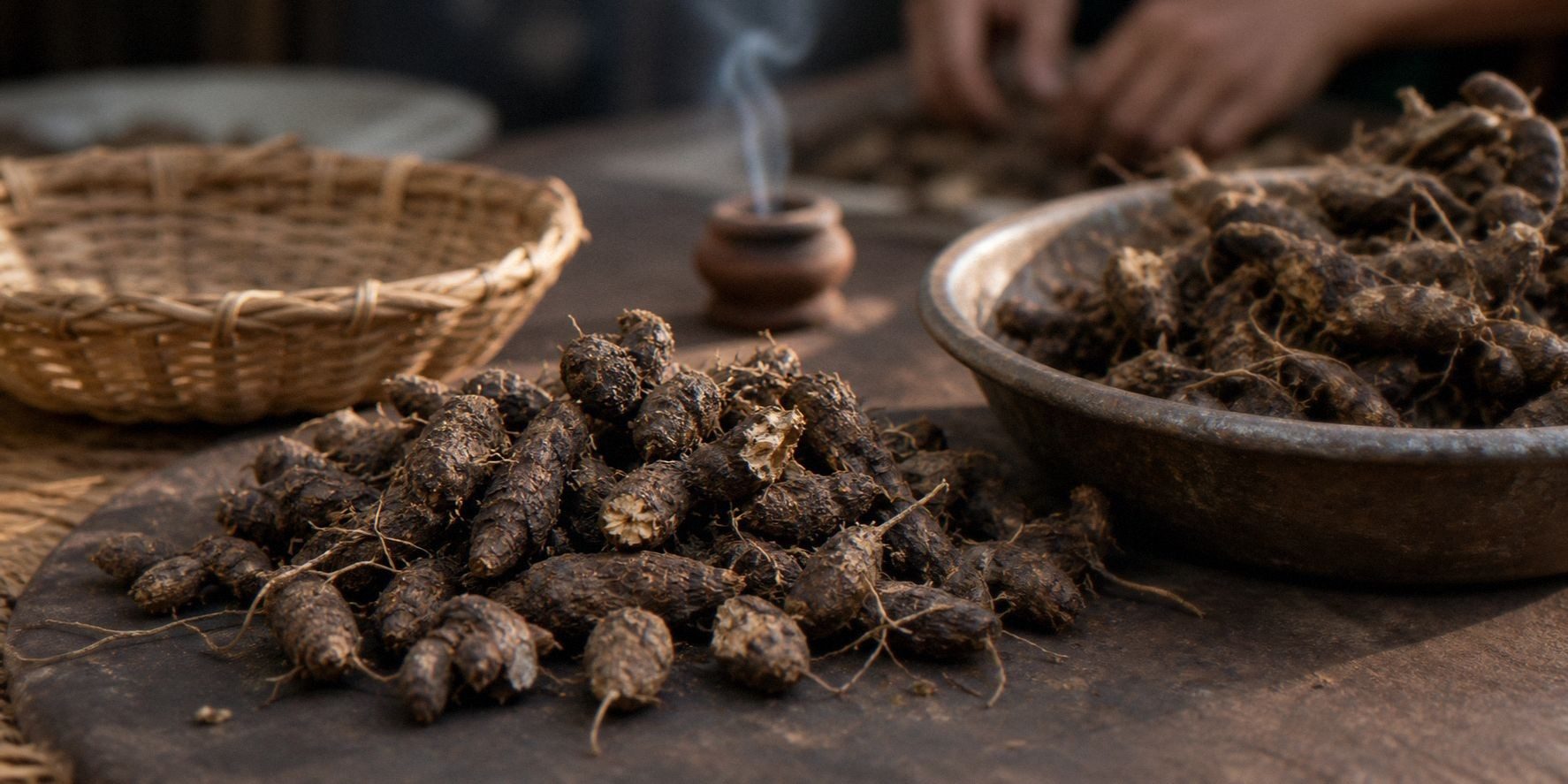
Voatsiperifery, or tsiperifery, is a liana of the pepper family that grows only in the natural forests of eastern Madagascar, from the coast up to the central highlands. It climbs its host trees into the canopy, where the berries ripen. It is dioecious, with male and female flowers on separate plants, so a picked-out stand loses its ability to set fruit long before it disappears.
It is often sold as Piper borbonense. CIRAD points out that it has no valid scientific name: that species is from Réunion, and the Malagasy pepper covers several morphotypes that differ in taste. For a buyer that is not pedantry, it means two lots under the same name may not be the same plant.
An adult liana yields 1 to 25 kilos of fresh bunches a season, about five on average, and it takes six to ten kilos of fresh pepper to make one kilo dried.
How voatsiperifery is harvested, and why it limits reproduction
The berries are high in the canopy and the trunks are smooth and hard to climb. So the most common method, documented by FOFIFA and by L’Express de Madagascar, is to fell the host tree, or to pull the vine down. Pickers also uproot lianas. Access is unregulated, including inside protected areas.
Each of those gestures removes a reproducing plant, or its support, for one season’s crop. A liana pulled down does not climb back. A felled tree takes with it the structure the next generation would have climbed.
The pressure is compounded by forest loss. An AFP report from October 2026 from Ambongamarina, 120 km north-east of Antananarivo, describes pickers who now walk almost a full day to find pepper, in a forest that was intact until 2010 to 2012 and has since been cleared by fire, charcoal and slash-and-burn. Madagascar lost 27% of its forest between 1990 and 2025. There is no national system tracking the harvest or the exports.
Why demand keeps rising on a wild voatsiperifery supply
Export interest started around 2008, mainly towards France, the United States and Japan, carried by chefs and spice merchants. Today voatsiperifery retails at 150 to 200 euros a kilo in France. At the other end, pickers sell fresh pepper at about 2,000 to 3,000 Ariary a kilo and collectors at about 4,000, cents of a euro.
That gap is the mechanism. The value is captured far from the forest, the picker is paid per kilo of fresh berries, and nobody in the chain is paid to leave a liana standing. A rising price with that structure accelerates the harvest, it does not protect the resource.
Can voatsiperifery be domesticated? What the trials show
CIRAD and FOFIFA have worked on it since around 2010, with four villages near Ambongamarina. The results are encouraging and modest at once. In two villages, propagation by cuttings and by seed was mastered, and three years after replanting, vine density had risen significantly, including outside the plots; villagers stopped pulling down vines and began watching over forest plots. The two other villages dropped out, because vanilla and passion fruit paid better.
The botany is not cooperative. Research published in 2023 found that rooting depends on which part of the plant is cut, stolons working better than side branches, and on the morphotype, and that germination depends on fruit maturity, which is exactly what an early, intensive harvest compromises. A private grower in the Mandraka forest found that cuttings taken from horizontal branches stop climbing altogether, and now grows 500 to 1,000 vines low on terraces, out of thousands of attempts.
So multiplication is possible, and it is slow, site-specific and dependent on villagers having a reason to prefer it over the next cash crop.
What a voatsiperifery buyer should ask before buying
Ask how it was picked. Felled tree, pulled vine or climbed liana: the answer tells you whether the lot cost the forest a plant.
Ask which morphotype, and from which forest. Under one trade name, the plant and the taste vary.
Prefer chains that sanction destructive harvesting. Organic certification gives some traceability, and some chefs are pushing for a certified harvest zone, but no standard yet guarantees a sustainable harvest. A charter that excludes torn-down lianas from export, like the one being drafted by the exporter quoted above, is the kind of commitment worth asking a supplier for. Until a standard exists, the guarantee is the relationship with the collector.
Price in scarcity. A wild resource harvested faster than it regrows, in a shrinking forest, does not become cheaper. The domesticated supply that could change that is years away.
Source: Prized wild pepper at risk in Madagascar's shrinking forests - Africanews (AFP)
Was this useful?
What was missing?
Noted, thank you. It goes straight to the editorial side.