Does an EU formula clear the ASEAN Cosmetic Directive?
By the LiaKea Beauty Tribe editorial team5 min read
Key figures
- Singapore cosmetic notification
Manufacturers and importers must notify before supply, ingredients and labelling are judged against the ASEAN Cosmetic Directive, and each notification is valid for one year
As of
- Notification is per member state, not per region
The ASEAN framework requires notifying the regulator of each member state where the product will be marketed. The rulebook is shared, the procedure is not
As of
- The two large rulebooks written outside Europe
China's CSAR in force since 1 January 2021, the United States' MoCRA enacted 29 December 2022, the first overhaul of US cosmetics law since 1938
As of
Selling a cosmetic into Southeast Asia adds a layer of complexity, and in our experience that layer is administrative rather than chemical. A formula that clears the European rules has a strong chance of clearing the ASEAN ones, and on the formulation side we have never actually hit the problem. What the region adds is market access work: notifications, local representatives, per-country procedures. It is real enough that we have the regulatory work done outside rather than in house.
That absence of a formulation problem is worth sitting with, because it is not a fact about chemistry. It is a fact about who writes the list.
Why the ASEAN Cosmetic Directive feels familiar to a European formulator
The architecture is the one a European formulator already knows: prohibited substances, restricted substances with their conditions, permitted colorants, permitted UV filters, positive lists for preservatives. The ASEAN Cosmetic Committee amends those annexes periodically, and it does so after reviewing what the European Union has decided, then choosing whether to follow (ChemLinked).
Reviewing then choosing is not the same as copying, and the alignment is not automatic. But the direction of travel is one way. Nobody in Brussels waits to see what the ASEAN committee restricts before amending Annex III.
What Singapore cosmetic notification actually buys
Singapore is where most brands enter the region, and the reasons are real: it is the distribution and brand-building base, the regulator is predictable, and the rulebook it applies is the one the neighbours apply too.
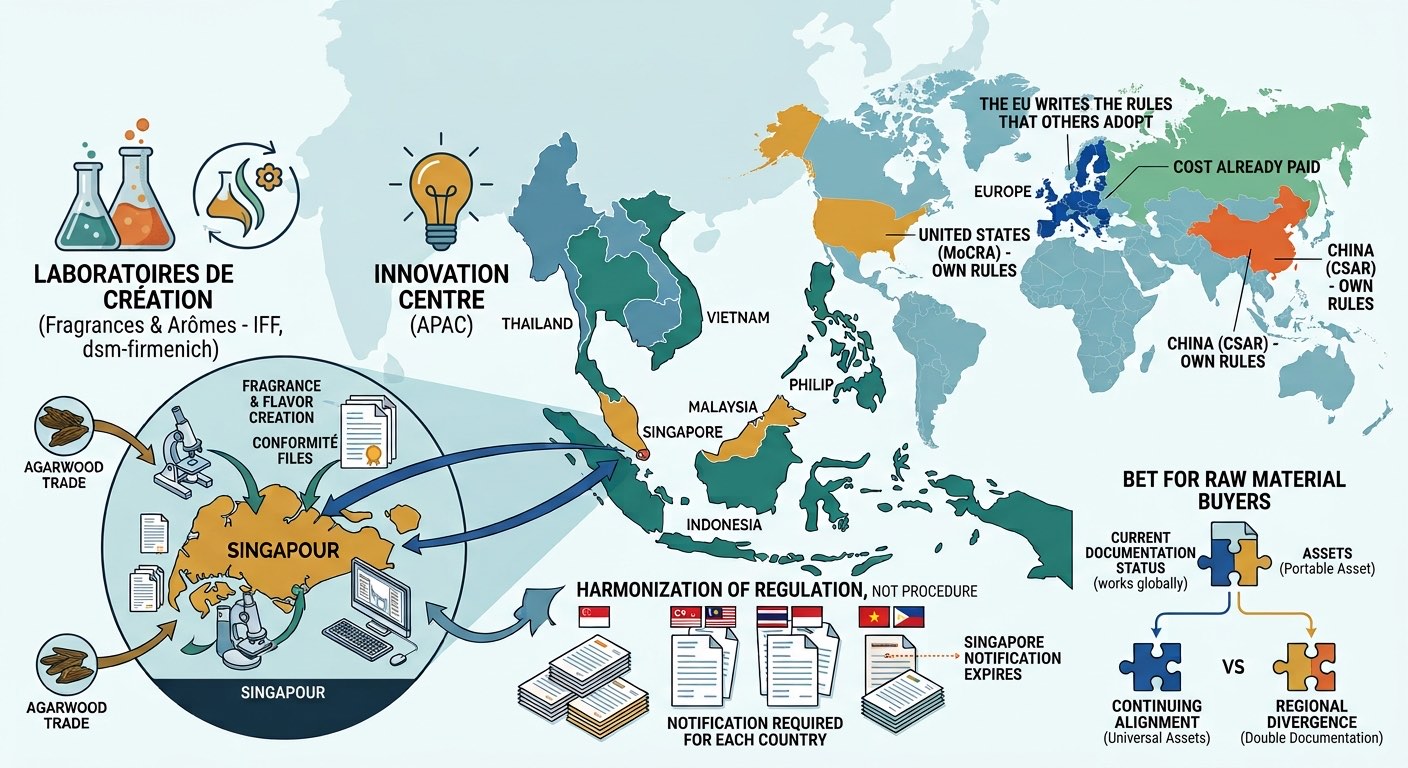
That last point produces a costly misunderstanding. Harmonisation in ASEAN harmonises the rulebook, not the procedure. The framework requires a company to notify the regulator “of each Member State where the product will be marketed”, each with its own process (ChemLinked). A Singapore notification buys Singapore. Malaysia, Thailand, Indonesia, Vietnam and the Philippines each want their own, on their own forms.
And the Singapore one expires. The Health Sciences Authority requires manufacturers and importers to notify before supplying, to verify that ingredients and labelling comply with the ASEAN Cosmetic Directive, and each notification is valid for one year (HSA). A European notification does not expire at all.
Nothing there is difficult. Everything there is recurring, per product, per country, and it scales with the size of a range rather than with revenue, which is the same shape of cost the 82-substance allergen list imposed on small brands in Europe.
What Singapore concentrates: creation labs, not crops
It is worth being precise about what the hub actually holds, because it explains why the regulatory question matters more there than the agricultural one.
Singapore’s own investment agency sells the country as “an ideal hub for brand and marketing functions”, and the fragrance and flavour infrastructure it lists is of the same nature: IFF runs a Regional Creation and Application lab for fragrance and flavour development, dsm-firmenich an APAC innovation centre, both oriented to product development for Asian consumers rather than to manufacturing (Singapore EDB). Eurofragance opened a plant there too.
So the region’s olfactive decisions, its formulation work and its compliance files concentrate on an island where none of the material grows. The same is true of what it buys: Singapore appears among the main importers of agarwood, alongside Saudi Arabia, the United Arab Emirates and Taiwan, in a global trade study of a material that only exists where there is forest (Global Ecology and Conservation, 2025, reported by Mongabay).
A hub is a place where decisions and documents accumulate away from where the crop is. That is precisely the geography that makes a rulebook, rather than a harvest, the thing worth controlling.
Regulation is the leader’s instrument, and the EU has been the leader
A rulebook that other markets reuse is not an administrative artefact, it is an export. Every restriction adopted in Brussels becomes, at some remove, a constraint on a formulator in Jakarta or Bangkok, and every reformulation the European industry has already absorbed becomes a head start when the same restriction lands elsewhere. Writing the standard means the rest of the world adjusts to a cost you have already paid.
That has held for a generation in cosmetics and fragrance, and the same asymmetry runs through the IFRA amendments and the way restrictions price complexity.
The open question is how long these markets keep accepting it.
EU cosmetic regulation vs US and China: two rulebooks written elsewhere
Two large markets have already answered. China’s Cosmetic Supervision and Administration Regulation has been in force since 1 January 2021, with its own new-ingredient management, efficacy substantiation and safety assessment requirements. The United States enacted MoCRA on 29 December 2022, the first serious overhaul of American cosmetics law since 1938 (ChemLinked).
Neither is an adaptation of the European text. Both are rulebooks written by markets large enough not to borrow one. That is the actual test of regulatory leadership: not whether your rules are strict, but whether anyone else finds it cheaper to adopt them than to write their own.
Southeast Asia has not made that choice. It is a bloc of eleven member states with no single regulator, Timor-Leste having joined in October 2025, where alignment on someone else’s annexes is cheaper than drafting and defending its own. Cheaper, for now.
What a raw material buyer should watch in the ASEAN annexes
For a sourcing operation the practical consequence is not a compliance question, it is a bet on where the documentation burden will point in five years.
Today a supplier who can produce a constituent-level allergen breakdown to European standards is, in effect, ready for ASEAN as well, which makes European documentation a portable asset. If the alignment holds, that asset keeps its value. If the region begins writing its own restrictions on its own schedule, the same supplier file stops being universal, and origin-side documentation has to be built twice.
Watch what the ASEAN Cosmetic Committee does with the next European amendment it reviews. Adopting it is business as usual. Declining one, on a substance where the European decision is contested, would be the first real signal.
Source: Cosmetic product notification - Health Sciences Authority, Singapore
Was this useful?
What was missing?
Noted, thank you. It goes straight to the editorial side.