Cosmetic development costs: what a quote leaves out
By the LiaKea Beauty Tribe editorial team6 min read
Key figures
- Quoted, three references, development to notification
6,400 development, 2,240 laboratory testing, 2,140 regulatory compliance, excluding tax, payable in two instalments with a 50% deposit. One supplier, one brief, May 2025
As of
- Compliance share of a development quote
About 20% on this three-reference quote, around 16% rebuilt for a single reference from the same unit prices. It rises slightly with the number of variants
As of
- Bespoke fragrance creation, separate
Invoiced by a British creator for a bespoke fragrance curation, applied samples included. Covers the juice only, not stability, compatibility or the regulatory file
As of
Everything below is negotiated. There is no tariff for cosmetic development, and the figures in this article are one supplier’s quote, on one brief, on one date. Put the same brief to three contract manufacturers and three different numbers come back, sometimes far apart, because each is pricing a relationship as much as a task: expected volumes, whether they will also manufacture, how much of the work they expect to win later.
So read what follows as an anchor point with its arithmetic exposed, not as a price list. What transfers from one project to the next is the structure and the proportions. The euros are one data point, and we publish the one we have rather than a range we would have to invent.
Where 10,780 euros goes on a three-reference range
A French contract manufacturer, 14 May 2025, for one base product and two variants, from development through to notification. Supplier not named, figures unchanged.
| Block | Amount | Share |
|---|---|---|
| Product development | 6,400 | 59% |
| Laboratory testing | 2,240 | 21% |
| Regulatory compliance | 2,140 | 20% |
| Total, excluding tax | 10,780 |
The unit prices matter more than the total, because they are what you rebuild your own case from.
Development: 4,500 for the conventional cosmetic product, 950 per variant. Testing: 300 per batch sent for testing, 290 per stability and compatibility test, 150 for the patch test, 200 for the challenge test, 60 per test management line. Compliance: 680 for the safety assessment report parts A and B, 480 per variant, 150 for the labelling conformity review, 200 for the product information file, 50 per reference for CPNP notification. The toxicological and regulatory pre-assessment is quoted at zero.
Rebuild that for a single reference and the bill lands near 6,600 euros, with compliance at roughly 16%. At three it is 20%. Add variants and the compliance share drifts up, because each one carries its own safety report, while the base development cost is paid once.
That drift is the useful part. Whatever a supplier quotes you, compliance should come out around a fifth. If a quote puts it at half, something else is being recovered there.
Why compliance is a fifth and reformulation is the real cost
That proportion reads as counter-intuitive to anyone who has watched the 82-substance allergen list land, or read about reformulation deadlines. The reconciliation is that two different costs wear the same word.
The compliance block is the cost of documenting a product that already works: writing the safety assessment, checking the label, assembling the file, notifying. It is bounded, priced per line, quoted in advance.
What is expensive is making the product work at all, and making it work again when a rule changes. A house that must rework a formula to meet a new restriction pays the 4,500-euro development line a second time, not the 680-euro compliance one. “European regulation is expensive” is true and misfiled: the expense is reformulation, and reformulation bills as development.
The cost that is not on the quote: 28 days here, weeks there
The quote prices work. It does not price time, and time is where a launch budget usually breaks.
Some durations cannot be compressed by paying more. A challenge test follows the product to 28 days under ISO 11930, with readings along the way, because the method is a measurement over time rather than a task (ISO 11930). Stability and compatibility testing run their own calendar, on their own samples, at their own temperatures. Neither starts until there is a formula worth testing.
Now add iteration. A formula that fails a test, or a texture the founder rejects, does not cost one line of the quote: it restarts a cycle. The laboratory work is re-quoted, and the calendar resets behind it.
Meanwhile the money has already moved. This quote is payable in two instalments with a 50% deposit, so half the development budget leaves at signature, months before there is anything to sell. That is the actual shape of the cash burn: a large early outflow, a calendar governed by test durations nobody controls, and revenue that cannot begin until production has run, which is itself after all of this.
For a founder, the practical consequence is that the number to model is not the quote, it is the quote plus the months. Two suppliers quoting within a few hundred euros of each other can be very far apart on when you can sell.
After development: sourcing, production, packaging, logistics
This is a development quote. It ends at a compliant, notified product that exists as a laboratory formula and a file. Everything that turns that into stock on a shelf is separate, and in most projects it is the larger half.
Raw material sourcing. Buying the materials at production volume, qualifying suppliers, obtaining the per-batch documentation the file assumes exists. That documentation is now a purchasing criterion in its own right, and suppliers who can produce it price accordingly.
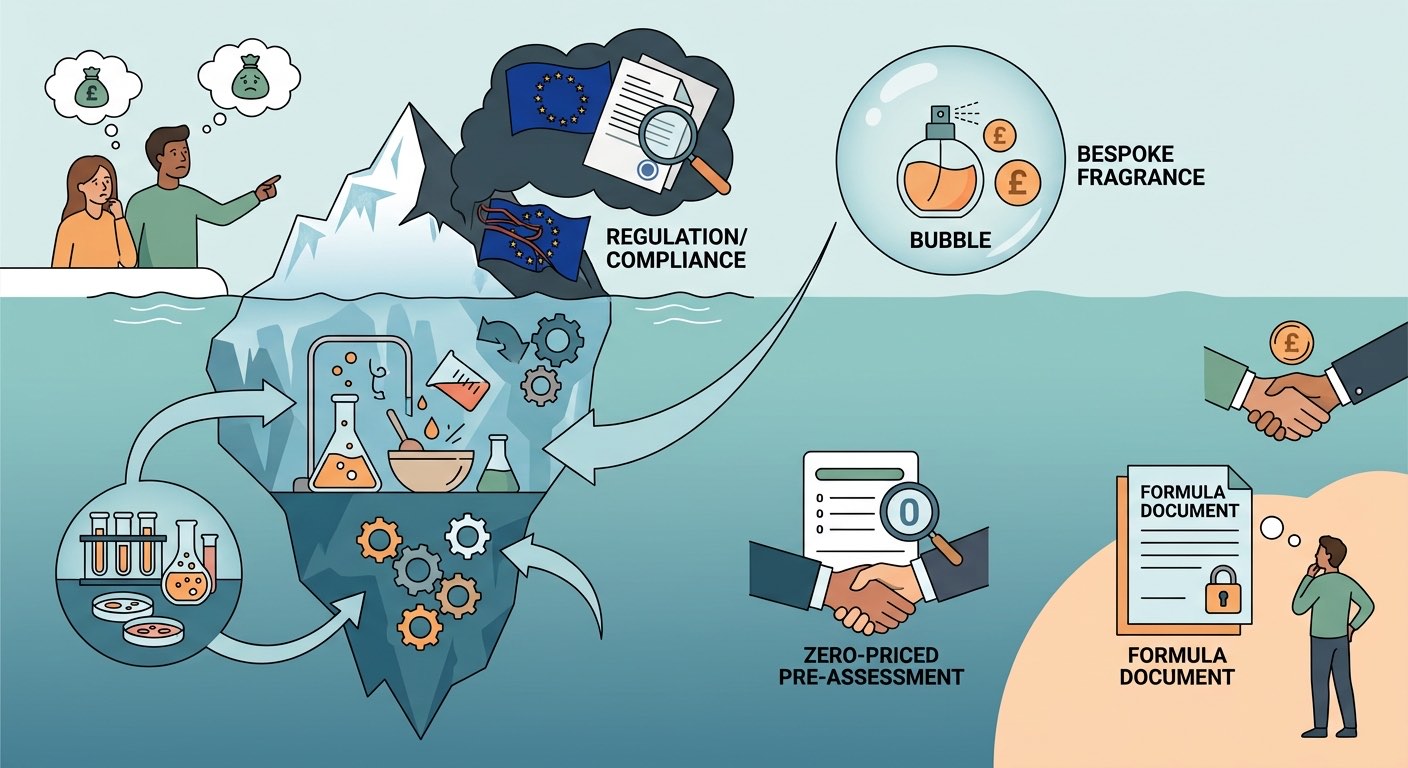
The fragrance. Not in the 10,780. A bespoke curation was invoiced separately by a British creator at 1,500 pounds, a level we charge at ourselves for the same work. It buys the juice, nothing else.
Production. A manufacturing run, with its minimum order quantity, which is what actually sets the size of the first cheque. Minimums in fragrance filling run from a few dozen units to ten thousand for a dedicated bottle, and that spread matters more to a launch budget than any line above.
Packaging. Components, tooling where a bespoke mould is involved, and their own minimums, usually on a different calendar from the juice.
Logistics, customs and storage. Finished goods have to move and to sit somewhere. Where they cross a border, add duty and the delay that comes with it: pallets held for weeks are working capital immobilised for an unknown period, and that delay cannot be quoted for the way a tariff can.
Registration in each destination market. The 50 euros per reference above is the European notification. The same product registered as an import into Nigeria costs about 1,252 dollars, roughly twenty times what a local manufacturer pays.
What 10,780 euros does not buy: the formula
The most important omission is not a line item.
Neither quote transfers ownership. The deliverable is a product you can sell, not a composition you can take to another manufacturer. Formula ownership is a separate negotiation, and at these sums most people never open it, because 1,500 pounds does not feel like the kind of purchase that needs a rights discussion.
It becomes one the first time a brand wants to change supplier, produce in another country, or reformulate without asking permission. That is the difference between a niche label and an independent house, and it is decided at the quote stage, years before anyone notices.
5 things to settle before signing a development quote
- Get more than one quote, and compare the structure. These are negotiated prices. If compliance is far from a fifth, ask what is being recovered where.
- Ask what the zero-priced line is recovering. A pre-assessment at zero is a commercial choice, and it is the line that decides whether your formula is viable.
- Ask for the calendar, not just the price. Test durations are fixed, iterations restart them, and the deposit is already spent while they run.
- Budget the juice, the production run and the packaging separately. The development quote is the smaller half.
- Settle formula ownership in writing, now. It costs nothing at signature and is close to impossible to obtain later.
Was this useful?
What was missing?
Noted, thank you. It goes straight to the editorial side.