
EU cosmetic regulation vs US: what MoCRA leaves out
By the LiaKea Beauty Tribe editorial team7 min read
Key figures
- Fragrance allergens to declare
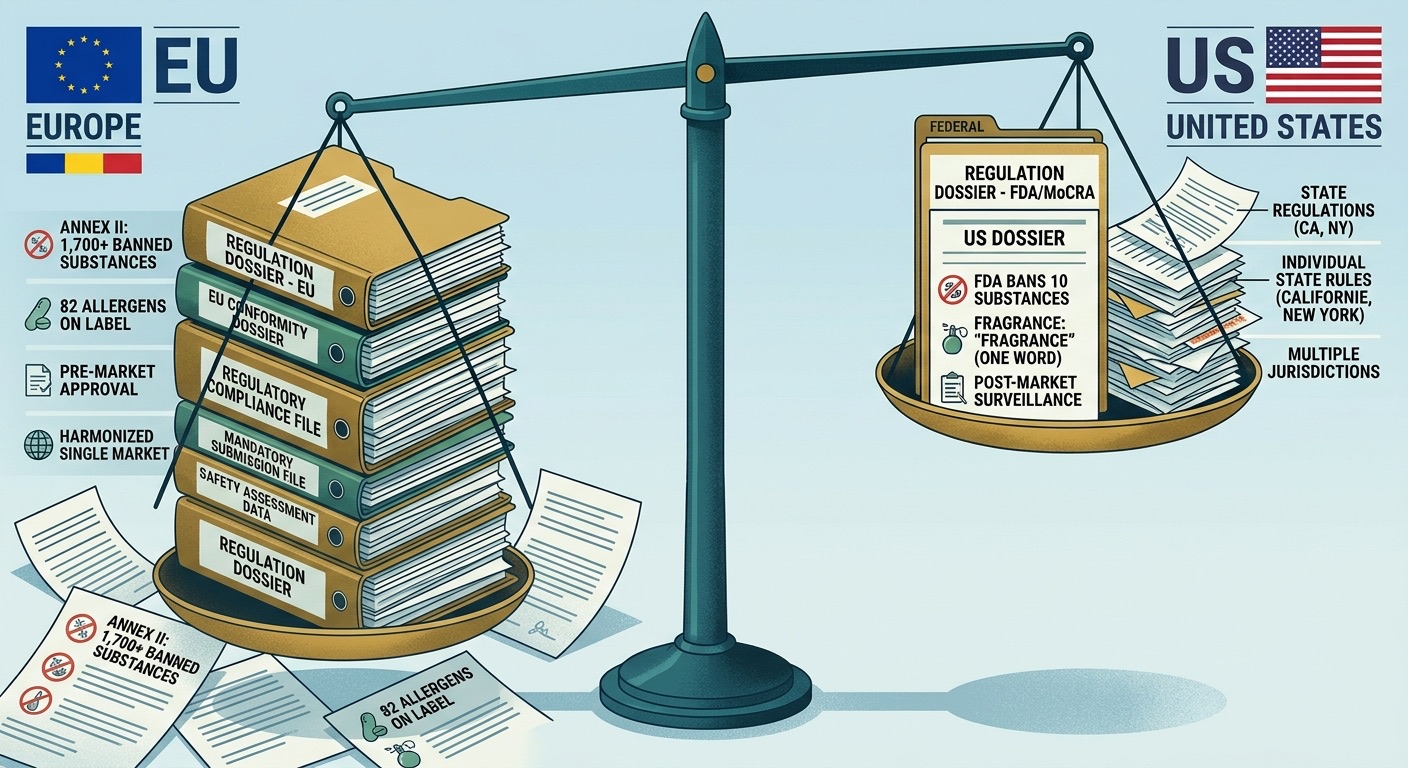
Up to 82 named substances on an EU label since 31 July 2026. None on a US label: the FDA rule remains unpublished
As of
- The US rule's statutory deadline
MoCRA required a notice of proposed rulemaking by 29 June 2024. The Unified Agenda still carries it at proposed stage, and nothing has appeared in the Federal Register
As of
- Prohibited substances, both sides
More than 1,700 under Annex II of Regulation (EC) 1223/2009, against ten prohibited or restricted federally by the FDA
As of
- Tariff on European beauty products entering the US
15% under the Turnberry agreement, in force since August 2025 and approved by the European Parliament on 16 June 2026. French cosmetics exports to the US fell 25% between Q4 2024 and Q4 2025
As of
Selling into the United States has never given us a formulation problem. What clears the European rules clears the American ones, and on the product itself the additional constraint is minor.
The cost is somewhere else, and it is not where the regulatory comparisons usually look. The laboratory that handles our regulatory and compliance work treats the two markets as two strictly separate dossiers. It does not build the American file from the European one. Nothing is carried over. The bill is not the European cost plus a margin, it is that cost twice.
Then the pallets sit in customs for weeks, and nobody can tell you in advance how many.
82 allergens on a European label, none on an American one
Since 31 July 2026, a cosmetic sold in the European Union must name each of up to 82 fragrance allergens present above 0.001% in a leave-on product or 0.01% in a rinse-off one, and 28 of those entries are natural extracts, which is why the burden lands hardest on natural formulation.
An American label names none of them. Fragrance can still be declared as “fragrance”, one word covering a composition of any complexity.
This was supposed to change. MoCRA instructed the FDA to identify fragrance allergens by regulation and require their disclosure, under sections 609(b), 602(b)(3) and 701(a) of the Federal Food, Drug and Cosmetic Act, with a notice of proposed rulemaking due by 29 June 2024. The rule exists as an entry in the Unified Agenda, “Disclosure of Fragrance Allergens in Cosmetic Labeling”, still at proposed stage, no final rule scheduled (RIN 0910-AI90). A Federal Register search for FDA documents citing MoCRA returns registration guidance, a talc asbestos testing proposal, recall guidance and records access guidance, and nothing on allergens.
Annex II prohibits 1,700 substances, the FDA prohibits ten
The gap follows from two different theories of the job.
The EU works from lists: Annex II prohibits more than 1,700 substances, Annex III restricts others under stated conditions, and colorants, preservatives and UV filters sit on positive lists the Scientific Committee on Consumer Safety assesses before use. Federally, the FDA prohibits or restricts ten items: bithionol, chlorofluorocarbon propellants, chloroform, halogenated salicylanilides, methylene chloride, prohibited cattle materials, vinyl chloride, zirconium complexes, mercury compounds and hexachlorophene (COSlaw).
Europe decides in advance what may be used. The United States decides afterwards whether you should have used it.
2 dossiers, not one superset: why the compliance bill doubles
Here is where the obvious inference fails, and it is worth naming because it is the inference everyone makes, this outlet included until a practitioner corrected it.
On content, the European file is a superset. A constituent-level allergen breakdown per batch answers the European requirement and would answer any American question, including the one the FDA rule will eventually ask. It looks like work you do once and reuse.
That is not how it is sold. The compliance laboratory builds the American dossier from scratch, on its own template, against its own checklist, without leaning on the European one. Whatever the technical overlap, the commercial unit is the jurisdiction, and you buy it twice.
Nothing in either regulation requires that separation. It is a property of the service market, not of the law, which means it is at least a question a buyer can put on the table: what, concretely, is reused between the two files, and what does the second one cost given the first exists. Most people never ask, because the two-dossier structure is presented as a fact of nature.
The consequence is a scale effect that runs the wrong way for small ranges. A doubled fixed cost is absorbed easily across two hundred references and painfully across five, the same asymmetry that the 82-substance list and every IFRA amendment produce.
California and New York set the real American floor
The other reason to distrust “the US is lighter” is that the federal layer is not the binding one. MoCRA’s preemption clause stops states from legislating on certain matters, but as COSlaw notes, “the preemption does not concern ingredients”. So states legislate on ingredients, and California and New York do it actively.
One European rulebook, heavy and singular, against a light federal rulebook and a moving set of state ones. The second is harder to systematise even though each requirement is smaller.
A 15% tariff, and pallets that sit in customs for weeks
On top of the doubled dossier sits a cost that has nothing to do with either regulator.
European beauty products entering the United States carry a 15% tariff under the Turnberry agreement, in force since August 2025 and approved by the European Parliament on 16 June 2026. French cosmetics exports to the US fell 25% between the fourth quarter of 2024 and the fourth quarter of 2025, and the lost exports are estimated at €541 million in 2025 plus around €250 million in the first half of 2026 (Personal Care Insights, 17 June 2026). FEBEA, the French industry body, is asking authorities to “mobilize efforts to secure a return to a 0% customs duty rate”.
The duty is the visible part and it is the manageable one, because it can be calculated. The unpredictability cannot. Pallets held at the border for weeks are working capital immobilised for an unknown period, delivery dates that cannot be promised, and a planning horizon that shortens for everyone upstream. A tariff is a number in a price list. A customs delay of unknown length is a risk you cannot quote for.
Why “banned in Europe” became an American marketing line
A gap of 1,700 substances against ten is not merely administrative, it is a story anyone can tell in one sentence. “Banned in Europe” became a standard American claim precisely because the European list is long, public and checkable, while the FDA’s is short. The claim is usually true and almost always incomplete: a substance restricted under conditions of use is not a substance banned outright, and Annex III exists to hold that distinction.
There is a symmetrical trap in Europe. A formula declaring eight allergens looks worse to a shopper than one declaring none, even when the second is the more synthetic of the two, because naturals carry more declarable constituents. Disclosure rewards simplicity, not naturalness, the same arithmetic that makes a 95% natural claim mostly a statement about solvent.
What to settle before quoting an American client
- Ask the compliance lab what is reused. Nothing in the law requires two independent files. If the answer is nothing, that is a commercial position, not a legal one, and it should be priced as such.
- Budget the dossier twice, and the delay separately. The duty is calculable, the customs wait is not, and only one of the two can go into a price list.
- Track the states, not only the FDA. Ingredient restrictions are where preemption does not apply.
- Do not plan around RIN 0910-AI90. More than two years past its deadline with no final rule scheduled, its arrival date is a guess.
- Treat “banned in Europe” as a claim you may have to support. When a client uses it about a competitor’s material, the prohibited-or-merely-restricted question lands on the supplier.
Source: Disclosure of Fragrance Allergens in Cosmetic Labeling, RIN 0910-AI90 - Unified Agenda
Was this useful?
What was missing?
Noted, thank you. It goes straight to the editorial side.