Perfumery's small arrangements: musk, alcohol-free, Grasse
By the LiaKea Beauty Tribe editorial team7 min read
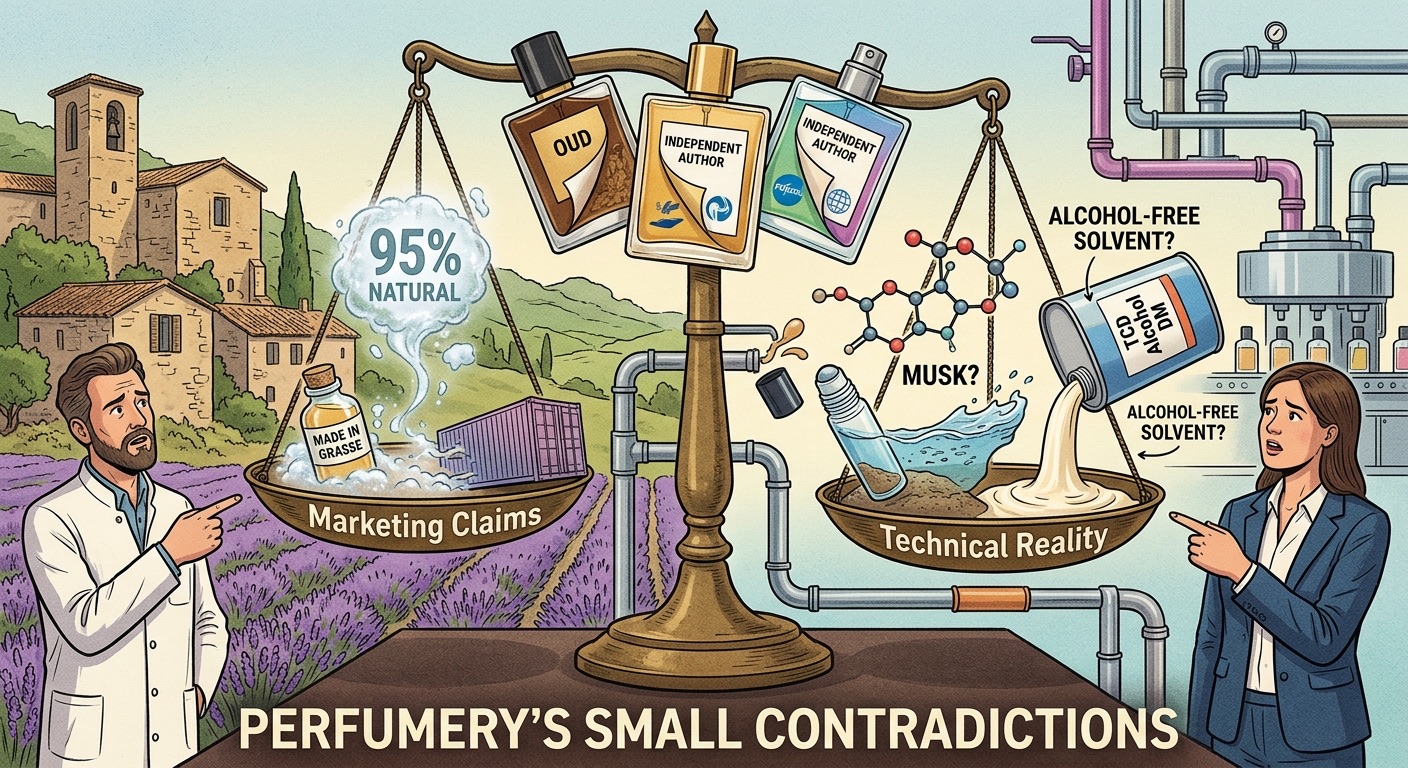
Perfumery runs on a set of small contradictions that everyone in the trade understands and no two people outside it read the same way. We deal with them as working questions, not as curiosities: they show up in briefs, in claims we are asked to sign off, in what a client believes they have bought. Start with a word you have seen on a hundred little roll-ons: musk.
The musk that isn’t a musk
To most buyers, a “musk” is a small alcohol-free roll-on, a pocket perfume oil: a fragrance concentrate thinned with a solvent, usually dipropylene glycol (DPG). The molecule doing the smelling is very often galaxolide, a synthetic polycyclic musk used as a base note and a fixative. Galaxolide is also one of the most contested molecules on the shelf, under long-running scrutiny for how persistently it turns up in water and sediment, and among the first names struck off a brief carrying an environmental claim. The soft, skin-like pocket musk is, often enough, a heavily debated synthetic, carried in a solvent that makes its “alcohol-free” label chemically arguable.
Which forces the real question: what is a musk? To a perfumer or a chemist it is an olfactory family, and that is a stranger category than it sounds. Alcohols, aldehydes and terpenes are defined by molecular structure, you can draw the group that puts a molecule in the class. Musks are sorted by smell alone: macrocyclic, nitro, polycyclic and alicyclic musks have almost nothing in common structurally, yet they share one character, and that character is the only thing that makes them musks. The class is a perception, not a formula. To the customer none of that exists: a musk is an alcohol-free perfume you carry in a pocket. Same word, two different objects.
“Alcohol-free” drifts the same way. In the profession it means ethanol-free, and everyone uses it that way honestly. But DPG is a diol, and a diol is an alcohol, so the alcohol-free oil is built on an alcohol. Nobody is cheating, the shorthand is accepted on all sides. It gets funnier with the creamy, thickened versions, which can be sold as a musk and contain no musk at all. That opaque body often comes from TCD Alcohol DM, tricyclodecane dimethanol, a diol its own manufacturer markets as a “non-alcoholic solvent” for alcohol-free systems. Read it back slowly: no musk in it, an alcohol in it, the word Alcohol in its name, sold as an alcohol-free musk.
The arithmetic of “95% natural”
The same gap opens, much wider, on naturalness, and this time a regulation supplies the arithmetic. A fragrance can be advertised at 95% natural origin and be, by volume, almost entirely solvent. An eau de parfum is typically 15 to 20% concentrate; the rest is ethanol and water. Ethanol is fermented from beet, wheat or cane, so under ISO 16128 it is a derived natural ingredient with a natural origin index of 1. Water is natural too. Before a single flower enters the formula, the bottle already sits at a very high natural-origin index, and the number the customer reads is, to a first approximation, a measure of how much alcohol is in it.
The other half is what the remaining fraction is allowed to be. The synthetic part is small, and the most restricted, most contested materials in the palette live precisely there. A formula can be 95% natural and carry, inside that last 5%, the one ingredient a customer would have refused on sight. Naturalness expressed as a share of mass says nothing about what the mass contains, and nothing in perfumery scales with mass: allergen thresholds, IFRA restrictions and labelling obligations all bite at levels far below one percent. Galaxolide from the opening is the plain illustration, and it works from the other end. It is not a trace material, it is a fixative carried at a few percent of the concentrate, rarely more than ten; but the concentrate is itself a fifth of the bottle, so one of the most widely used and most contested molecules in the industry lands inside a rounding error on a naturalness figure that is, first of all, a ratio of mass in a bottle that is mostly ethanol.
And the number itself is a choice. ISO 16128 gives a natural index and a natural origin index, which are not the same thing, and nothing forces you to compute either on the finished juice rather than on the concentrate. The same formula legitimately yields several different percentages. The brand picks the flattering one, and it is not lying when it does.
This is the version of the problem we actually meet: the percentage arrives on the brief as a target rather than as a result. From there the work is no longer making the formula more natural, it is finding the calculation basis that reaches the figure already printed in the marketing deck. Both are called formulation. Only one of them changes what is in the bottle.
Made in Grasse, and made where?
Origin claims work by the same mechanism. “Made in France,” and more strongly “made in Grasse,” are read by customers as statements about where the perfume was created and where its materials came from. Legally they are statements about where the last substantial operation happened, and filling and boxing are operations. A concentrate compounded elsewhere, from materials bought on four continents, shipped in, diluted, filled and packed in Grasse, can carry the mention without anyone falsifying a document. Grasse is not a protected designation of origin. What UNESCO listed in 2018 is the know-how of the Pays de Grasse as intangible heritage, which protects a practice, not a provenance printed on a box. Asked whether a given product may carry the mention, the answer is very often yes, and the speed of that yes is exactly what should trouble whoever asked.
Niche brands, composed by the giants
Then authorship. A brand can be independent, small, founder-led, sold explicitly as the antithesis of industrial perfumery, and have its juices composed by one of the handful of groups that compose nearly everything else on the shelf. “Independent” describes who owns the brand, not who wrote the formula. Inside the trade this isn’t a scandal: briefing a large house is how almost everyone works, including brands with real creative direction and excellent taste. It becomes a contradiction only when the marketing sells the opposite of the way the product was actually made.
The bill arrives as perfume dupes
None of this is a failure of honesty, it is a shared professional dialect, and that is what makes it hard to fix. The chemist, the perfumer, the marketer, the regulator and the customer can all use “musk,” “alcohol-free,” “95% natural” or “made in Grasse” correctly by their own definition and mean five different things. The same slippage runs through the rest of the palette: most perfumes sold as “oud” contain no natural oud at all, a synthetic accord standing in for a material whose origin and authority already sit in two different places, and “natural,” “essential oil” and “attar” each carry a technical meaning alongside a looser commercial one.
Each contradiction is defensible on its own. Stacked, they teach the customer one lesson: the words on the box do not describe the object in it. That lesson is what the dupe market is built on.
The usual explanations for dupes are price, TikTok, or the decline of taste. The less comfortable one is that buying a copy at a fifth of the price is a rational decision for someone who has concluded they were never paying for what the label claimed. If “natural” is an accounting method, “made in Grasse” is a logistics step and “independent” is a shareholding structure, then the premium isn’t on the liquid, it’s on the story. And stories are cheap to copy. The industry didn’t lose that argument to the copyists; it handed it to them, one technically-true claim at a time.
So we will put the question back the way a perfumer would, to anyone who sells this for a living: an alcohol-free musk with an alcohol in it and no musk in it, 95% natural because it is mostly ethanol, made in Grasse because that is where the caps went on. How exactly do you explain that to your client, and what do you say when they buy the dupe?
Source: A Look at TCD Dimethanol use in Fragrance Formulation - Perfumer & Flavorist
Was this useful?
What was missing?
Noted, thank you. It goes straight to the editorial side.