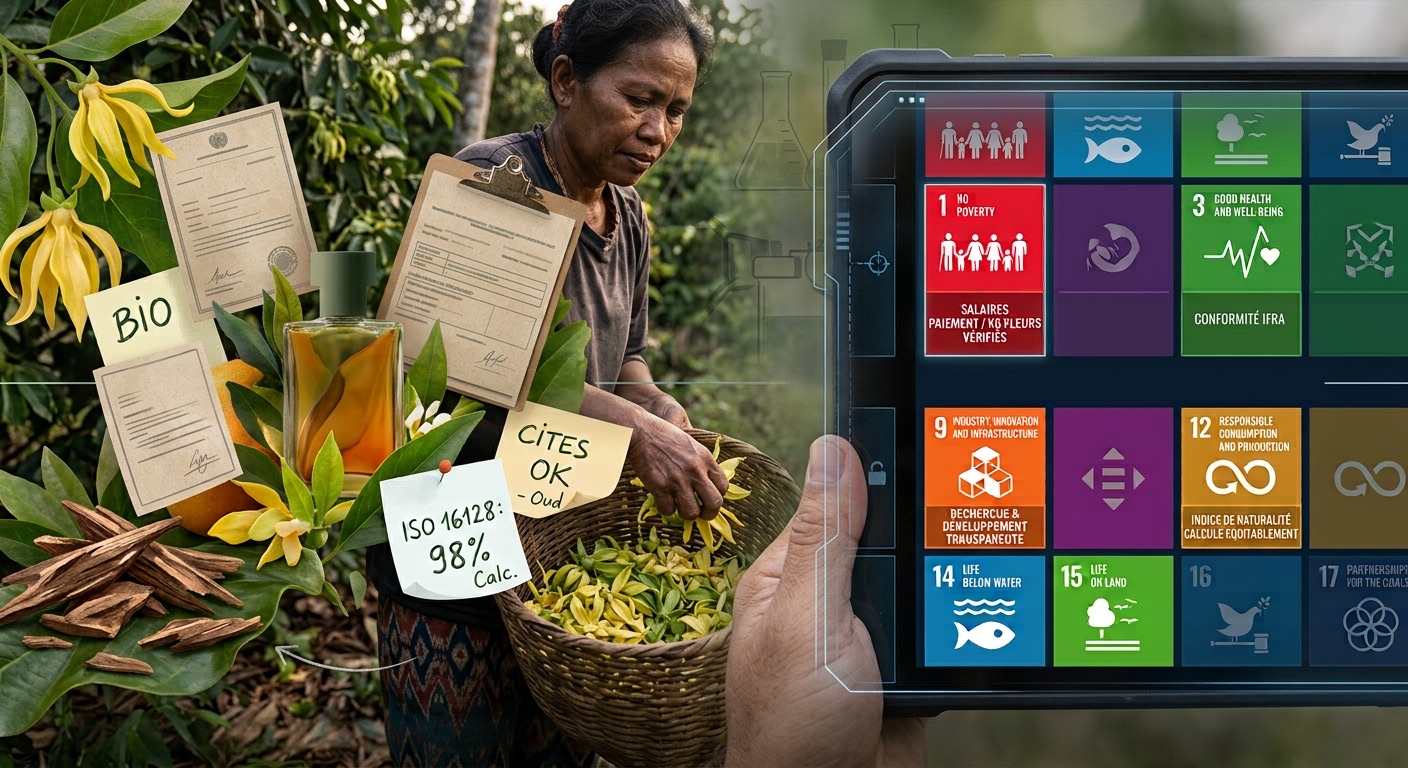
Why is oakmoss banned, and what saved bergamot?
By the LiaKea Beauty Tribe editorial team6 min read
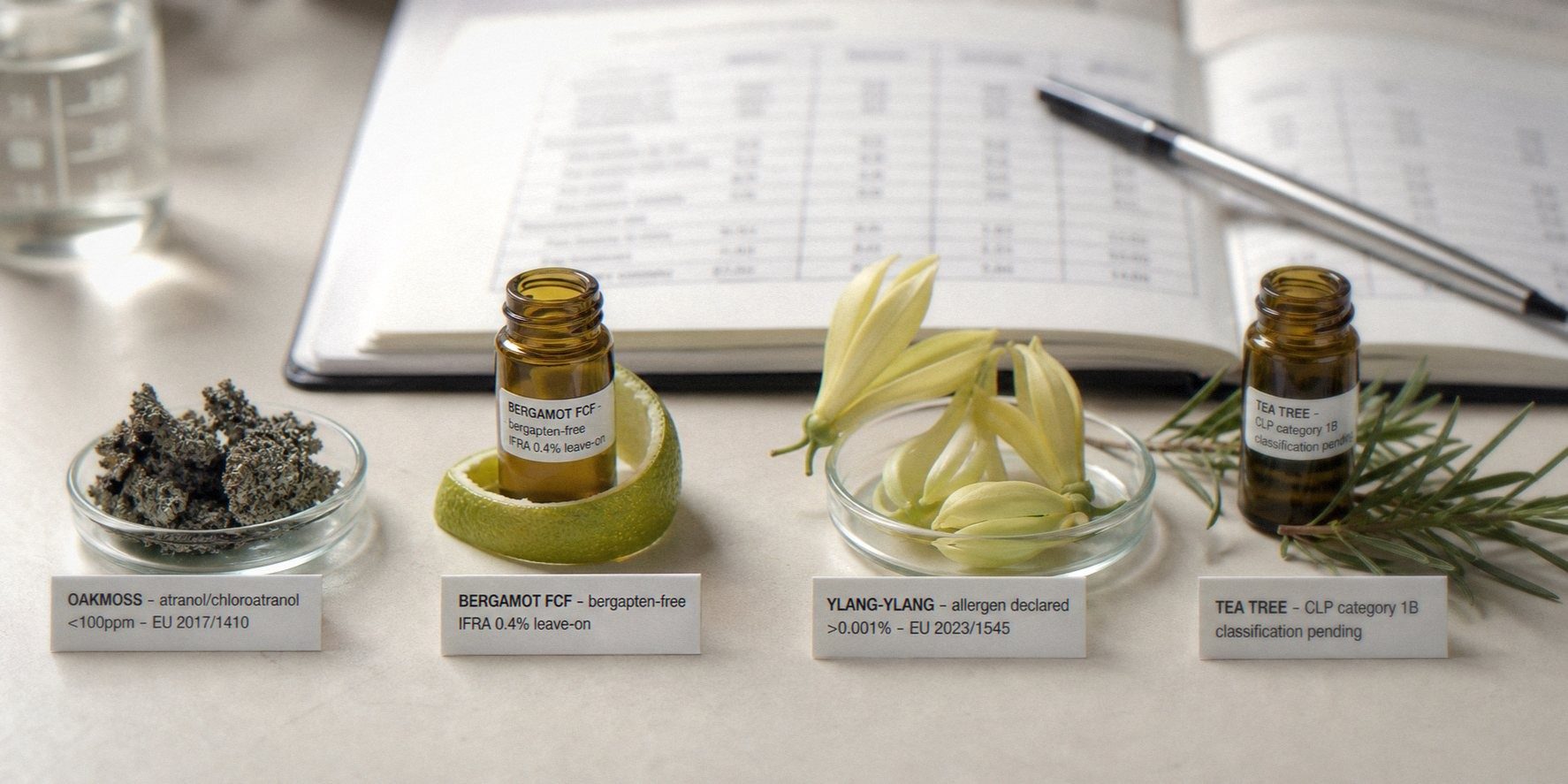
Regulation is usually described as a single force pressing down on the fragrance industry: a new IFRA amendment, a new EU allergen threshold, one more restriction to absorb. But the same regulatory tool, applied to different raw materials, produces wildly different outcomes. Bergamot met a restriction and came out of it stronger. Oakmoss met one and lost the genre it defined. Madagascar’s ylang-ylang is absorbing a new compliance cost on top of a supply chain that was already fragile for entirely different reasons. And tea tree is, right now, the live test of whether reacting fast is even enough. What determines the outcome isn’t the severity of the rule, it’s the structure of the supply chain underneath it.
Bergamot: the industry that got ahead of the rule
Bergapten, the molecule that made cold-pressed bergamot oil phototoxic on sun-exposed skin, has been flagged since the early 1990s: IFRA recommends capping expressed bergamot oil at 0.4% in leave-on products applied to skin exposed to sunlight, and by 1995 the EU had banned bergapten-rich bergamot oil for tanning use outright (PMC). The industry’s answer arrived just as fast: bergamot FCF, furocoumarin-free oil produced by vacuum distillation, chemically comparable to the cold-pressed original but stripped of the phototoxic fraction, became the default supply for anything applied to skin (PMC).
Three decades later, Calabria’s bergamot economy isn’t a regulatory casualty, it’s a going concern. The region still produced 22,000 to 24,000 tonnes of fruit in 2025, yielding 120 to 130 tonnes of essential oil sold at €180 to €220 per kilogram, across roughly 1,800 to 2,200 micro-farms (KiTalent). The restriction never touched the material’s core identity in perfumery, the top-note brightness that opens most fine fragrances, only the version of it applied directly to skin. That’s the difference a technical fix, deployed early, can make.
Oakmoss: the material the rule left behind
Oakmoss had no equivalent workaround. IFRA’s restrictions tightened in stages from 1988 onward, a 0.1% usage ceiling by 2001, a cap on the allergenic compounds atranol and chloroatranol under 100 ppm by the late 2000s, then an EU regulation banning them above trace levels altogether by 2017, phased into full market removal by 2021. Unlike bergapten, atranol and chloroatranol can’t be cleanly stripped out while leaving the material’s signature intact: purified extracts and synthetics like Evernyl reproduce roughly 60% of oakmoss’s dry, woody character, but the “dark gravity” that anchored the chypre family, the genre Coty built in 1917 on bergamot brightness set against mossy depth, never fully came back (Première Peau). Perfumers call the reformulated results “phantom chypres”: same bottle, diminished structure. Bergamot lost a use case. Chypre lost its foundation.
Ylang-ylang, Madagascar: a compliance bill a fragile chain can’t easily absorb
Madagascar’s ylang-ylang trade, over sixty tonnes of oil a year, some 80% of it from small local distilleries around Nosy Be and Ambanja, didn’t need a new regulation to be in trouble (Jacarandas International). Overplanting during the 2014-2018 price boom collided with US-China trade tensions and then COVID-19 demand collapse, driving prices to a low point in 2021 that pushed many growers to abandon their plots rather than keep harvesting at a loss. That’s a market and climate story first, not a regulatory one, the same structural fragility already visible in how little of the value from Comorian ylang-ylang reaches the pickers at the base of the chain.
Regulation now lands on top of that fragility rather than causing it. Ylang-ylang absolute is a complex natural mixture that typically contains citronellol, geraniol, eugenol, farnesol and linalool together, several of them now among the 82 substances the EU requires disclosed above 0.001% in leave-on products once Regulation (EU) 2023/1545 took full effect on July 31, 2026 (COSlaw.eu). Meeting that requires batch-level allergen documentation from every supplier, exactly the kind of traceability investment a well-capitalized, single-region operation like Calabria’s bergamot consortium can fund and a fragmented network of smallholder distilleries, still rebuilding from a multi-year price collapse, has far less room to make. Same paperwork, very different capacity to absorb it.
Tea tree: the case still being decided
Tea tree oil is the one still in motion, and it’s a different kind of threat entirely. In November 2023, the EU’s Risk Assessment Committee adopted an opinion classifying tea tree extract as a Category 1B reproductive toxicant, a hazard class that, once formally added to the EU’s list of prohibited cosmetic substances, triggers a default ban rather than a use restriction, the exact pathway that already ended Lilial’s run in EU cosmetics in March 2022 (ph-Plex). Then, in November 2025, the European Commission’s own scientific committee published a separate opinion finding tea tree oil safe when used as an anti-seborrheic and antimicrobial agent in specific product types (The Spectator Australia), two EU scientific processes pointing in different directions on the same material, with no final decision taken as of this writing.
Australia isn’t waiting passively. Tea tree oil is a $40 million annual export trade for the country, with the EU absorbing roughly 30% of it (The Spectator Australia), and that exposure is driving a real defense. The Australian Tea Tree Oil Industry Association has committed $1.2 million to safety research and compliance dossiers, already spent $600,000 on EU-facing documentation, funded comparative liver-cell studies through a Netherlands lab since Australia bans cosmetic animal testing at home, and adopted its own audited Code of Practice (The Land). It’s the same proactive posture that saved bergamot. Whether it’s enough is a different question: a graduated IFRA-style restriction leaves room for a technical fix like FCF distillation, a CMR reprotoxic classification under EU chemicals law does not, it’s binary. Tea tree is testing whether reacting early still matters when the regulatory instrument itself no longer allows for a middle ground.
What decides whether bergamot survives and oakmoss does not
Four materials, one pattern: the rule’s severity matters less than whether a supply chain has the capital, the concentration, and the technical option to respond before the deadline lands. Calabria had a PDO-protected, geographically concentrated industry and a clean substitution (FCF distillation) available decades before it needed it. Chypre’s oakmoss had neither, an irreplaceable olfactive signature with no adequate synthetic stand-in. Madagascar’s ylang-ylang has the will but not yet the capital, the same asymmetry already reshaping how the wider allergen disclosure expansion is playing out across natural sourcing. Tea tree has both the will and the capital, and still might lose, because the regulatory category it’s fighting doesn’t bend the way IFRA’s restriction model does. For buyers building a sourcing strategy around any natural material, the useful question isn’t just “how strict is the coming rule,” it’s “does this supply chain have a technical way out, and can it afford to take it before the deadline decides for them.”
Source: Oakmoss, IFRA & The Regulation That Killed Chypre - Première Peau
Was this useful?
What was missing?
Noted, thank you. It goes straight to the editorial side.