Why the patchouli shortage keeps coming back
By the LiaKea Beauty Tribe editorial team8 min read
Key figures
- What a West Sulawesi patchouli farmer is actually paid
1,400,000 rupiah (about $86) per kilo of oil from the distillery owner who buys it, against a quoted farm-gate ceiling of 2.4 million rupiah (about $147)
As of
- How long a patchouli field lasts
Two harvests. After that the plot is left and a new one cleared, which is why supply grows by taking new land rather than by intensifying existing fields
As of
- Indonesia's share
Over 80% of the global patchouli oil market, grown and distilled largely by smallholders in Sulawesi, Sumatra and Java
As of
“Patchouli shortage” is one of those queries that gets typed by the same person more than once. Not because the answer changed, but because the shortage came back. Anyone who has bought Indonesian patchouli across more than one cycle has watched the price run up, watched supply arrive, watched the price fall through the floor, and then found themselves short again eighteen months later.
The usual explanation is weather, and for most naturals that is a fair first answer: a single origin, a narrow climatic band, and one shock is enough to move a global market, which is the pattern behind most fragrance raw material shortages. For patchouli it is close to the wrong one. The recurrence is built into how the plant is grown and who grows it.
Why Indonesia supplies over 80% of the world’s patchouli
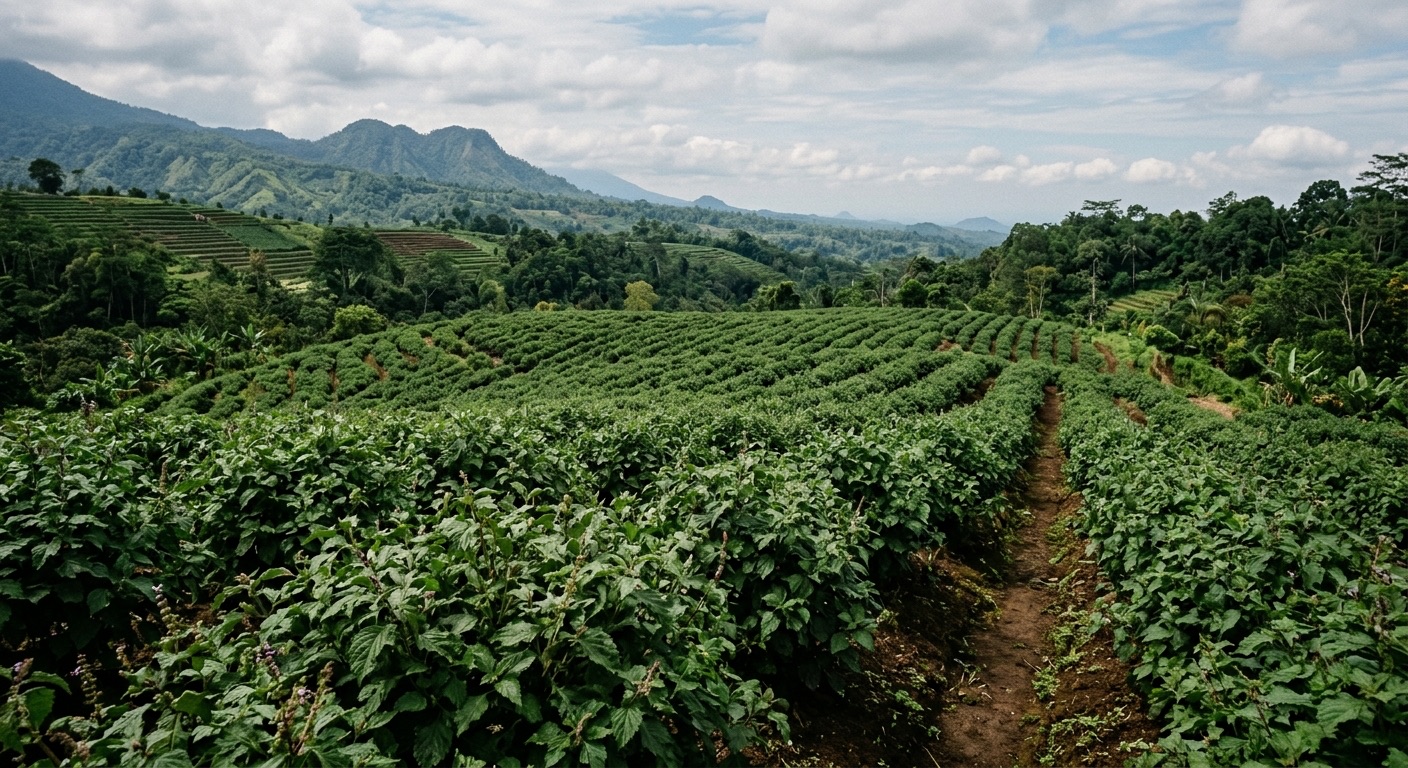
Patchouli oil comes from the leaves of Pogostemon cablin, a bushy perennial in the mint family, native to Southeast Asia. Indonesia supplies over 80% of the global market, with cultivation and distillation concentrated in Sulawesi, Sumatra and Java.
The part that matters for supply is not the geography, it is the structure. This is not a plantation crop run by a handful of estates. It is grown on one and two hectare plots by smallholders, dried on the porches of their houses, and distilled in small village facilities. Every characteristic of the supply curve follows from that.
Why a patchouli field only lasts two harvests
Patchouli takes a field apart. It can be grown on the same land twice, and then the plot is finished and a new one has to be cleared.
That one fact does more to explain the shortage cycle than any weather event. It means supply cannot be increased by farming existing ground harder. It can only be increased by taking new ground. And in West Sulawesi the new ground is rainforest.
The Associated Press followed this on the island in early 2025. Hardi, 36, works a one-hectare plot with his mother and brother, has already taken his two harvests, and planted on a steep hillside that costs him a half-hour walk uphill. Thousands of seedlings sit in plastic cups further into the forest, which is a fairly precise leading indicator of next season’s tonnage.
Zulkifli Manggazali, who heads West Sulawesi’s Environment and Forestry Agency, has been explicit that patchouli should not be planted on slopes of 45 degrees or more: “Because when patchouli is planted there, there will be erosion, flooding, and landslides.” In January 2025 a landslide in Mamuju killed a family. Local authorities said patchouli planting was not the main factor, but that it played a part, because patchouli had been planted nearby. We covered the same dynamic from the climate side in what climate change does to fragrance prices, where patchouli turns up as a driver of deforestation rather than a victim of it.
What a patchouli farmer in Sulawesi is paid per kilo
Two prices appear in the AP reporting, and the distance between them is the whole economics of the crop.
The quoted ceiling for farmers is 2.4 million rupiah, about $147 a kilo of oil. What Hardi actually receives is 1,400,000 rupiah, about $86, from the owner of the distillery that processes his leaf. That distiller is his only link to the exporters, most of whom sit on Java. Hardi does not know where his oil ends up.
So the grower captures a little over half of an already modest farm-gate figure, and has no visibility past the first buyer. It is the same shape we found on ylang-ylang in the invisible labor behind Dior’s bottles: the person carrying the agronomic risk is the one with the least information about the price.
Why the patchouli price cycle repeats instead of correcting
Here is the mechanism, and the first half of it is documented rather than inferred.
Hardi did not start with patchouli. He grew cloves, and moved because the harvest cycle was long and prices were falling. That is the switching behaviour, observed directly: a smallholder on one hectare can change crop in a season, and does, when the numbers stop working.
The inference is that the same door swings the other way, and that is what produces the cycle. Price runs up, land gets cleared and planted, supply lands twelve to eighteen months later, price falls through break-even, growers move to whatever is paying, and the shortage rebuilds. Cloves, cocoa, corn and palm are all sitting there as alternatives. Trade reporting through 2025 and the first half of 2026 describes exactly this phase: prices eased off the previous run-up and sat too low for many growers to break even.
It is the vanilla pattern with a shorter period, and we traced that one in the Madagascar price yo-yo. The difference is that a vanilla vine takes three to four years to produce, so the correction is slow and violent. Patchouli replants in months, which should damp the cycle, except that the two-harvest limit means replanting requires new land, and new land requires a price high enough to justify clearing it.
Why the distillery queue caps Indonesian patchouli supply
There is a second bottleneck that never shows up in a tonnage forecast.
Haruna, 42, a farmer in Simboro, waited several weeks in line with his father-in-law for a slot at a modest steam distillation facility an hour’s drive from his farm, then worked through the night stoking the boiler with firewood. Leaf existing is not the same as oil existing. Distillation capacity is its own constraint, and the firewood it consumes comes out of the same forest.
This is also where quality variance is born. Freshly distilled patchouli has a sharp green edge and needs months resting in sealed containers before it is what a perfumer wants, which is why aged oil carries a premium over fresh in every market note. Above that sit the grades a fine fragrance buyer actually specifies: iron-free “light” oil, and molecularly distilled material with patchouli alcohol typically in the 29 to 34% range. Village distillation in iron vessels does not produce those directly.
The practical consequence is that the number a buyer feels is never the crop number. When trade sources put Indonesian production somewhere around 1,000 to 1,200 tonnes against demand of a similar or larger order, the gap that bites is not oil against no oil. It is specification-compliant, rested oil against everything else.
Communelle, and why a patchouli lot has no single origin
Everything above is written in terms of plots, hillsides and individual growers. Almost none of it survives the journey to a European bench, and the reason is ordinary trade practice rather than a scandal.
Patchouli circulates as communelles: lots from many distillations blended together to hold a stable profile. By the time an oil is offered to a buyer, it is an average of a large number of plots, seasons and stills. Short of working directly with a single producer, and even then the guarantee is thin, you do not know what you have bought in the sense the sections above describe.
Our own practice follows from that, and we state it without enthusiasm: we source patchouli from wholesalers. Past a certain amount of communelle, one supplier’s oil is not meaningfully different from another’s, so paying for a provenance story would be paying for a claim nobody can substantiate. Nor is there much negotiating: on this material the price is that or nothing, the market sitting under tension more or less permanently.
That is the part worth sitting with, because it breaks the chain this piece has just described. The two-harvest limit is real. The cleared hillside is real. The gap between what the farmer is paid and the quoted farm-gate ceiling is real. And none of it is attributable to the drum in front of you. A buyer who wanted to pay more for the plot that was not cleared on a 45-degree slope has no way to identify it, which is the same verification problem examined in sustainable fragrance: CITES, traceability, and who pays, arriving from the other end: not a certificate that cannot be trusted, but a material that cannot be traced at all.
What the patchouli cycle changes for a raw material buyer
None of this gets fixed upstream on a useful timescale. The two-harvest limit is agronomy. The smallholder structure is not going to consolidate. The Givaudan Foundation has run distillation and agricultural training with more than a thousand smallholder patchouli communities in Indonesia, which is real and worth more than a certificate, but it improves the quality distribution rather than the cycle. It also runs into the question we opened in sustainable fragrance: CITES, traceability, and who pays: a grower who sells to one distiller and does not know where the oil goes is not in a position to produce the evidence any sustainability grid asks him to be scored on.
What is actually controllable sits on the buyer’s side: which grade you specify and whether you can accept a wider one, whether you hold aged stock through the cheap part of the cycle rather than buying into the expensive part, and whether your contract horizon is longer than the eighteen months it takes the cycle to turn. The houses that stockpile are not being clever about patchouli specifically. They are the only ones who can afford to sit out a phase.
Was this useful?
What was missing?
Noted, thank you. It goes straight to the editorial side.